
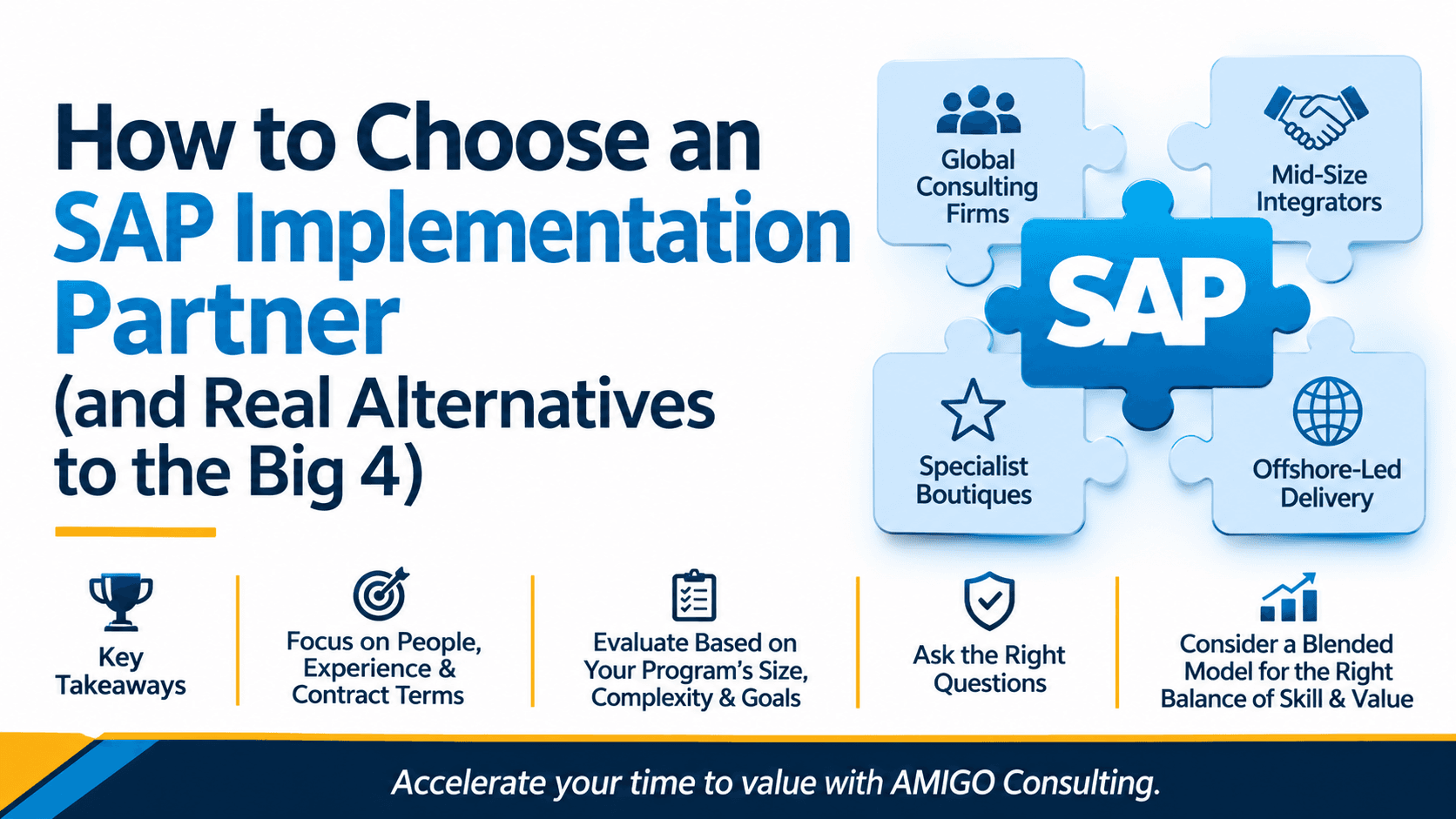
Who this is for: SAP CoE leads, CIOs, IT directors, VPs of Enterprise Applications and CFOs who are selecting a partner for an SAP ECC or S/4HANA program, or rethinking the one they have.
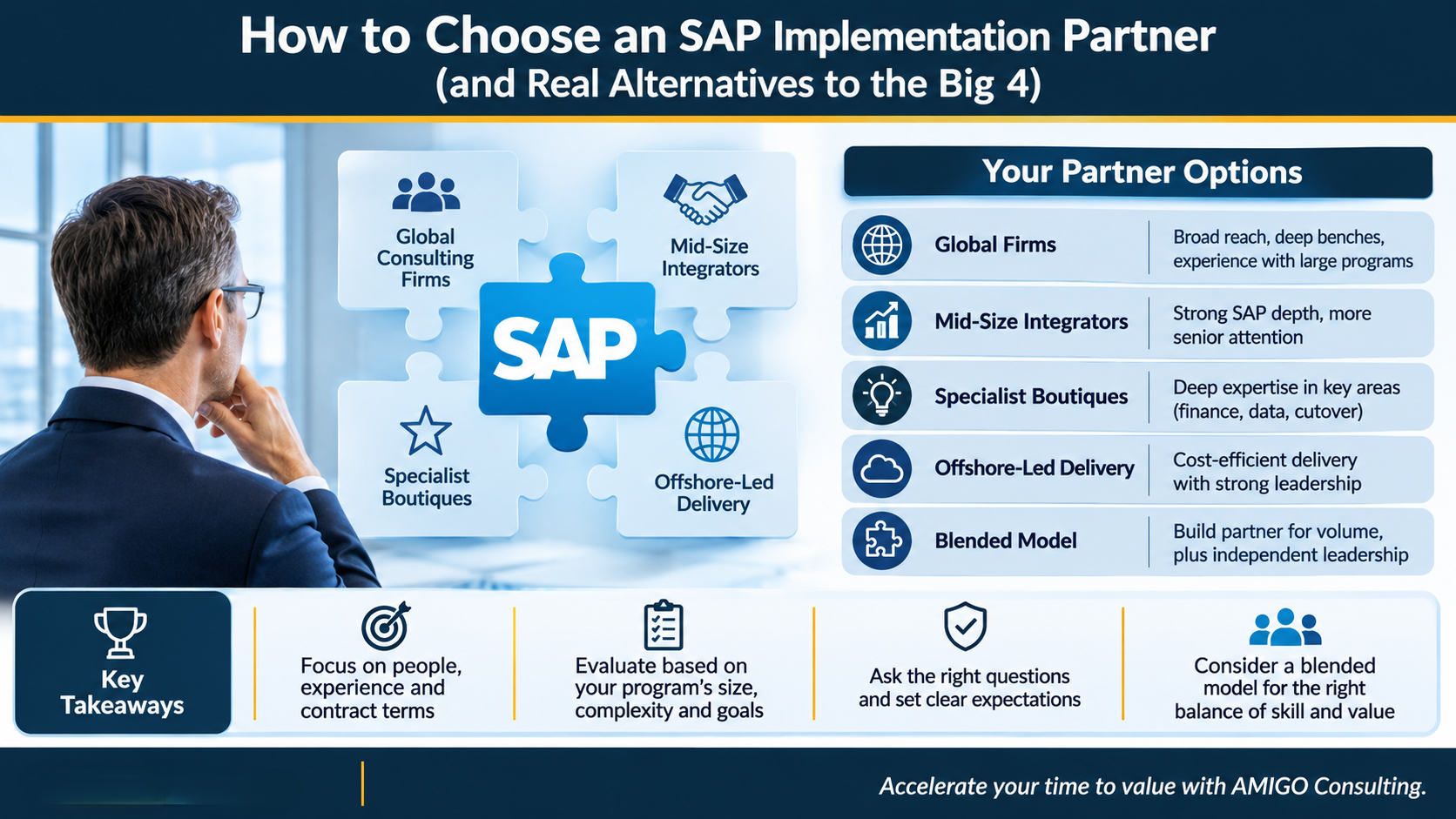
What are the alternatives to Accenture or Deloitte for an SAP implementation?
Large global firms such as Accenture, Deloitte, EY, IBM and Capgemini lead many of the biggest SAP programs. They bring global reach, deep benches and established methods. They are not the only option, and for many programs they are not the only sensible one.
| Partner type | Typical strengths | Watch for |
|---|---|---|
| Global consulting and IT services firms | Global coverage, large benches, industry depth, capacity for very large programs | Leverage models that put less experienced staff on the work; senior attention spread across many accounts |
| Mid-size SAP-focused integrators | Strong SAP depth, more senior attention per client, flexible commercial terms | Limits on bench depth in some modules or regions |
| Specialist boutiques | Deep expertise in a domain such as finance, cutover, data or program recovery; senior people doing the work | Limited bulk capacity for large build and test teams |
| Offshore-led delivery firms | Cost-efficient build, test and support capacity | Needs strong onshore leadership and clear requirements |
| Blended model | A build partner for volume, plus an independent firm for program leadership, PMO and quality assurance | Requires clear roles and a single integrated plan |
The blended model deserves more attention than it gets. A large or offshore partner handles configuration, development and testing. An independent firm supplies the program director, PMO, cutover lead or quality assurance role, and answers to you rather than to the build partner.
How do I choose an SAP implementation partner?
Start from the program, not the vendor list. Define what you need before you see a single proposal.
- Write down what the program must deliver. Scope, regions, business units, key integrations, and the business outcome you are paying for.
- Be honest about your own team. Can you supply a strong program director, process owners and data owners? The weaker your internal bench, the more leadership you need to buy.
- Build a shortlist from evidence. SAP's Partner Finder lists partners and shows competency and specialization details on their profiles. Add peer recommendations and firms you have seen deliver.
- Run scripted sessions, not sales presentations. Give each firm a real problem from your program, such as a finance design question or a data migration risk, and watch how their proposed people work it through.
- Interview the named team. Meet the program lead, solution architect, functional leads, data lead and cutover lead you will actually get.
- Call references for programs of similar size and scope. Ask what went wrong and how the firm handled it.
- Test the plan. Ask how the timeline was built and what assumptions sit under it. A plan reverse-engineered from your target date is a warning sign.
- Negotiate the contract around people and outcomes. Named resources, substitution rules, milestone acceptance criteria and change-order pricing.
Selection scorecard
| Criterion | What good looks like |
|---|---|
| Named senior team | Specific people with SAP programs of similar size on their record, committed for defined periods |
| Relevant experience | Recent programs in your scope, version and deployment approach |
| Plan quality | Built from the work, with explicit assumptions on testing, data and business availability |
| Capacity | Enough people in each critical skill, not just the right skills on paper |
| Commercial terms | Clear milestones, acceptance criteria, change-order pricing and exit terms |
| Cultural fit | Willing to deliver bad news early and in writing |
| References | Recent clients who will speak frankly, including about problems |
What questions should I ask an SAP system integrator before signing?
Proposals are written to win. The contract is what you live with. Ask these questions and get the answers into the contract:
- Who exactly is on the team, at what level, and for how long?
- What happens if a named person leaves or is moved to another client? Who approves the replacement?
- How much of the work is done onshore, nearshore and offshore, by role?
- How was the plan built, and what does it assume about business availability, testing cycles and data quality?
- How many mock data loads and cutover rehearsals are included?
- Who leads testing, and who writes and runs the test scripts?
- How are change requests estimated and priced?
- What are the acceptance criteria for each milestone payment?
- What happens commercially if the go-live date moves, and whose fault is it?
- Which references can we call for a program of similar size, and may we speak to the client's program lead directly?
- What are the exit and transition terms if we need to change partners?
Why are Big 4 SAP implementations so expensive?
Cost is driven by what you are buying, not only by the rate card. Large firms invest in global methodologies, accelerators, training, industry teams and the capacity to staff hundreds of people. They also carry the commercial risk of very large programs. All of that is built into their pricing.
Their delivery model typically pairs a small number of senior leaders with a larger number of less experienced consultants. That leverage can work well when the senior people stay engaged. It becomes expensive when the program needs senior judgment every day and gets it once a week.
Program cost also grows from things that have little to do with the firm's brand: unclear scope, slow business decisions, poor data, and plans that were never realistic. Any partner, large or small, will cost more on a program with those problems.
Who are the best mid-size SAP consulting firms in the US?
There is no single independent ranking of mid-size SAP firms, so treat online "top firms" lists with care and check how they were compiled. The better question is which firms are best for your program. To find them:
- Use SAP Partner Finder to filter by solution and location, and review the competency and specialization details on each profile.
- Ask peers in your industry which firms they would hire again, and which they would not.
- Look for firms whose senior people have led programs of your size, in your modules, recently.
- Check whether the firm can cover your full scope, or whether you will need a second partner for some areas.
How do I avoid paying senior rates for junior SAP consultants?
This is the most common complaint buyers have about SAP partners of any size. Contract terms protect you better than promises:
- Name every critical role. Program lead, solution architect, functional leads, data lead, integration lead, testing lead and cutover lead.
- Interview before signing. Treat critical roles like hires.
- Price by role and level. A single blended rate hides the mix. Ask for a rate card by role and experience, and an expected mix by phase.
- Control substitutions. Require your written approval for replacements, with equal or better experience, and a handover period at the firm's cost.
- Use a short trial period. Give yourself the right to replace any consultant who is not performing in the first weeks.
- Track who does the work. Compare planned against actual hours by person and role every month. If senior hours fall while junior hours rise, ask why.
Is a smaller SAP partner riskier than a Tier 1 firm?
It carries different risks. Neither size is automatically safer.
| Risk | Smaller partner | Large partner |
|---|---|---|
| Bench depth | Fewer people to draw on if someone leaves | Large bench, but replacements may be less experienced |
| Senior attention | Senior people often on the work every day | Senior people may cover many accounts |
| Financial capacity | Smaller balance sheet | Large balance sheet and insurance |
| Flexibility | More flexible on terms and staffing | More standardized contracts and processes |
| Scale | Limited for very large build and test teams | Can scale to very large programs |
A practical way to manage size risk is to confirm that each critical role has a named backup, check the firm's financial standing and insurance, and avoid giving a small firm work it cannot staff. Many organizations reduce risk further by using the blended model: a larger partner for volume work, and a senior independent firm for leadership and assurance.
Are boutique SAP consulting firms a good choice for a large program?
They can be, for the right roles. A boutique that has led programs of similar size can supply the program director, PMO, solution architects and specialist leads. Where boutiques are usually thin is bulk capacity: large development, testing and data teams. On a large program, use a boutique where depth and judgment matter most, and pair it with a firm that can supply volume.