
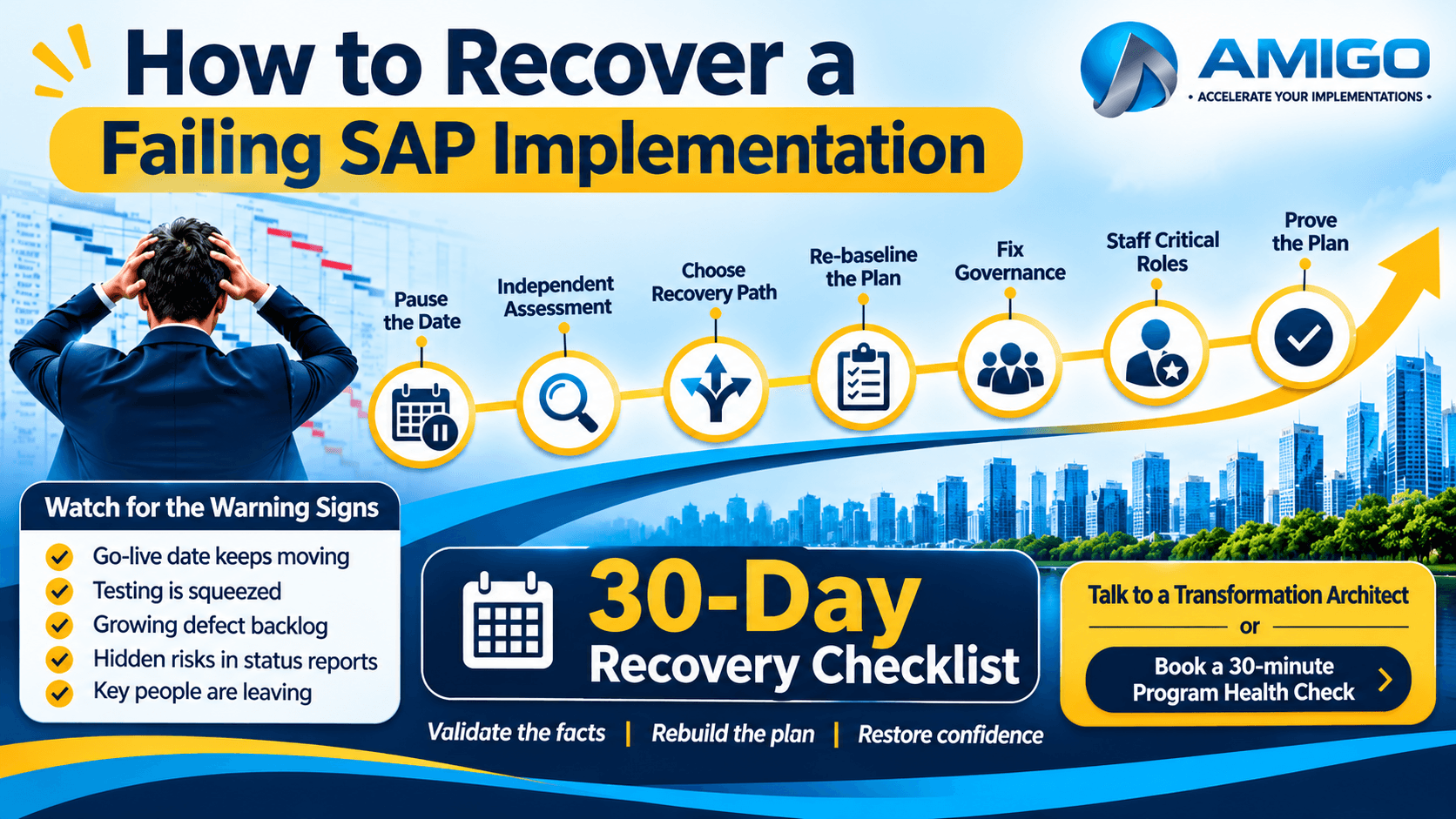
Who this is for: CIOs, VPs of Enterprise Applications, ERP program directors and CFOs whose SAP ECC or S/4HANA program is late, over budget, or losing the confidence of the business.
How do I know our SAP implementation is failing?
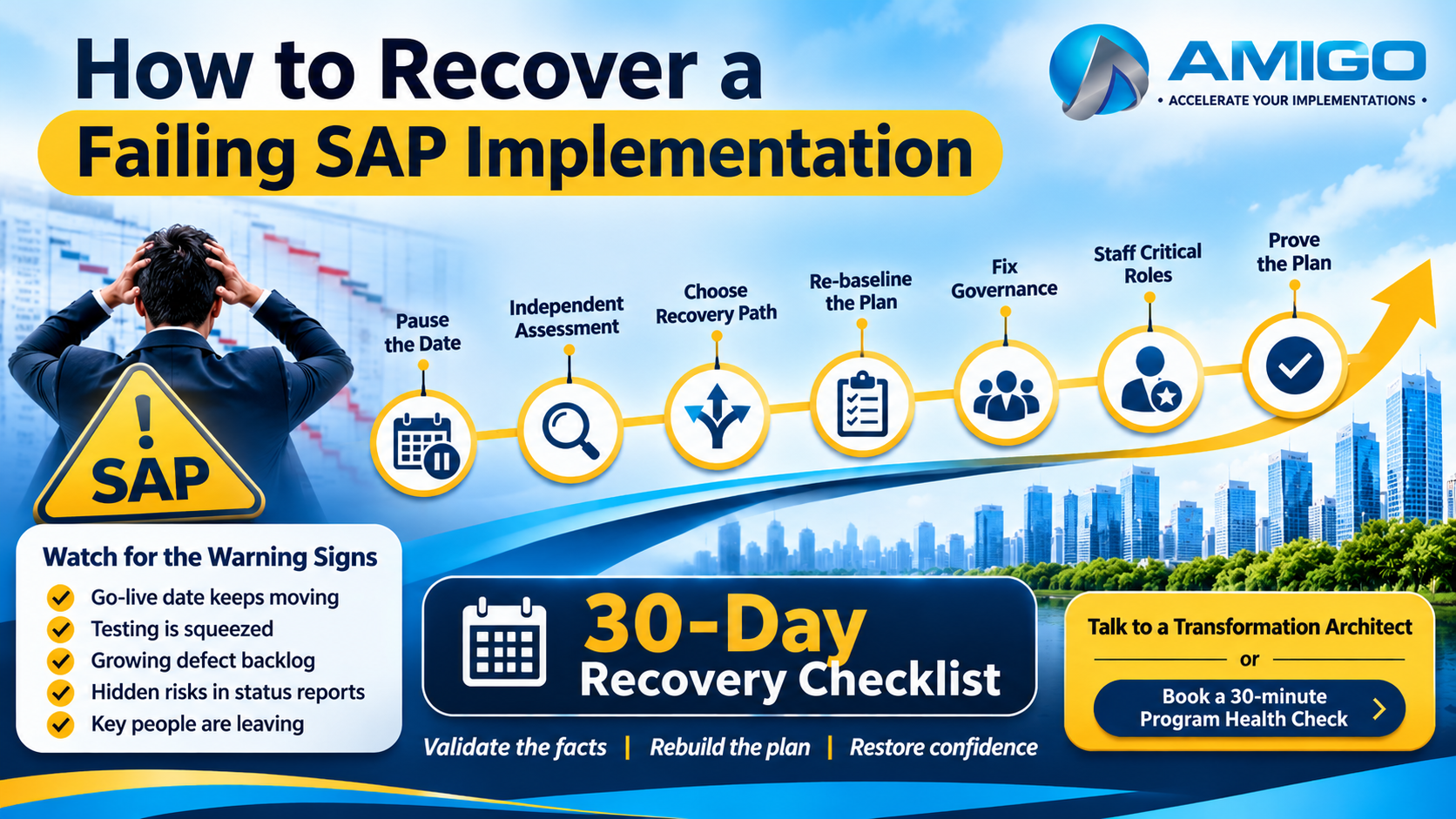
Programs rarely fail in one dramatic moment. They drift. The warning signs show up months before anyone says the word "failing" out loud:
- The go-live date moves, but the plan doesn't change. A new date is announced without a new, credible plan behind it.
- Testing keeps getting squeezed. Integration and user acceptance testing shrink to protect the date.
- The defect backlog grows faster than it closes. Especially critical defects in finance, order-to-cash or supply chain.
- Status is green, but the room is anxious. Reports say "on track" while team leads quietly say otherwise. If that sounds familiar, your status reports may need a new color: watermelon, green on the outside and red on the inside.
- Big decisions are still open. Design choices that should have been settled in the blueprint phase are still being debated in build or test.
- Data isn't ready. Mock data loads fail or are skipped.
- Key people are leaving. Turnover in your integrator's team or your own core team.
- The business has stopped showing up. Process owners skip workshops and testing because they have lost faith or lost time.
If two or more of these are true on your program, treat it as a program in trouble and get an independent view.
Why SAP programs go off track
The visible symptoms are usually schedule and budget. The root causes sit underneath:
| Root cause | What it looks like on the ground |
|---|---|
| Unrealistic original plan | The timeline was set to win the deal or meet a board date, not built from the work |
| Scope that never stopped moving | Change requests absorbed without re-planning |
| Weak governance | Steering committees that receive updates but don't make decisions |
| Junior delivery team | Senior people sold the work; less experienced people are doing it |
| Business not engaged | Decisions delayed, testing done by the integrator instead of the business |
| Data underestimated | Data cleansing and migration treated as a technical task late in the program |
| Status reporting that hides risk | Nobody is rewarded for raising bad news early |
The last one matters most. When honest reporting is risky, problems surface only when they can no longer be hidden, which is usually too late to fix cheaply.
How do you rescue a troubled S/4HANA project?
A recovery follows the same basic sequence whatever went wrong:
- Pause the date, not the work. Stop committing to new go-live dates until the plan is validated. Keep the team working on the highest-value items.
- Get an independent assessment. Someone without a stake in the current plan reviews where the program truly stands (see below).
- Decide what you are recovering to. Same scope on a later date, reduced scope on a nearer date, or a phased go-live. Each has different costs and risks.
- Re-baseline the plan from the bottom up. Build it from remaining work, real team capacity and realistic test cycles, not from the date you wish you had.
- Fix governance. Smaller steering committee, clear decision rights, a weekly risk review, and status reporting tied to measurable progress rather than opinion.
- Put the right people in the critical seats. Usually a recovery program director, an experienced cutover lead, and senior functional leads in the areas with the most defects.
- Prove the new plan early. Hit the first few milestones of the re-baselined plan exactly. Credibility with the business comes back one kept promise at a time.
What does an SAP project recovery assessment include?
A good assessment is fast, independent and frank. AMIGO Consulting runs an accelerated quality assurance assessment that follows our quality assurance methodology. As challenges surface, we work through the existing project plans in parallel to pinpoint pain points and areas for improvement, so replanning starts before the assessment ends. It covers:
| Area | Key questions |
|---|---|
| Scope and design | What is truly in scope? Which design decisions are still open? |
| Plan and critical path | Is the plan built from real work? What drives the end date? |
| Deliverables and sign-offs | Have the planned deliverables been produced, reviewed and formally signed off, and how do actual sign-off dates compare with the original plan? |
| Build and test status | How much is truly finished and tested, not just "in progress"? |
| Defects | Volume, severity, aging and fix rate by area |
| Data readiness | Status of cleansing, mapping and mock loads |
| People and capacity | Are the right skills in place on both sides, and is there enough capacity in each skill to clear bottlenecks and hit the re-baselined dates? |
| Governance | Who makes decisions, how fast, and on what information? |
| Commercials | What does the contract say about change orders, milestones and exit? |
| Business readiness | Training, change management and process owner engagement |
It should end with a clear verdict, two or three recovery options with their cost and risk, and a recommended path.
Capacity: the question most recovery plans skip
A re-baselined plan is only as good as the people available to execute it. Having the right skills on the team is not enough. You need enough capacity in each critical skill to meet the new commitment dates. Recovery plans often fail a second time because the work piles up behind one or two people: a single FI/CO architect reviewing every finance design, one data lead running every mock load, or a handful of business testers asked to clear hundreds of test scripts.
Before you commit to new dates, test the plan against capacity:
- Map remaining work to the skills it needs. Count the work by skill area, not just by phase.
- Find the bottlenecks. Look for any role where demand in the coming months exceeds the hours available, especially single points of failure that only one person can do.
- Check the business side too. Process owners, testers and data owners are often the tightest constraint, and they still have day jobs.
- Close the gaps before you publish the plan. Add people in the bottleneck skills, cross-train, reduce or resequence scope, or move the date. Do not count on overtime to absorb a structural shortfall.
- Track it weekly. Capacity shifts as defects surface and people leave, so compare planned against actual effort by skill every week and act before a gap turns into a missed milestone.
If the capacity isn't there, the new dates aren't real, and a second missed baseline does far more damage to credibility than the first.
Should we replace our system integrator in the middle of an SAP project?
Sometimes, but rarely as the first move. Switching integrators mid-stream means lost knowledge, a ramp-up period and a commercial negotiation, all while the business waits.
| Replacing the integrator makes sense when… | Fixing the current relationship makes sense when… |
|---|---|
| The assessment shows the integrator cannot staff or lead the recovery | The core team knows the system and the problems are in leadership or governance |
| Trust has broken down on both sides | The integrator accepts the assessment and commits senior people |
| The contract structure rewards delay | The contract can be reset around new milestones |
A common middle path is to keep the integrator for build and support, and bring in independent program leadership, quality assurance or specific senior roles to change how the program is run.
How long does it take to turn around a troubled ERP program?
It depends on the size of the initiative and how far it has drifted:
- Accelerated assessment and replanning: a few weeks (typically three to eight, depending on the size of the initiative). Because replanning runs alongside the assessment, the new plan is ready soon after the findings are.
- Stabilization: one to three months to reset governance, staff critical roles and prove the new plan with early milestones.
- Delivery to the new go-live: whatever the re-baselined plan requires, which is why that plan must be built from the work, not the wish.
The fastest recoveries are the ones that start early, while there is still budget, goodwill and time to choose.
Your first 30 days: a recovery checklist
- Freeze new go-live commitments until the plan is validated
- Commission an independent assessment with a fixed end date
- Pull the real defect, test and data-load numbers, not the summary slides
- Collect all program deliverables for detailed analysis, including final sign-off dates against the original planned dates
- Interview team leads on both sides, without their managers in the room
- Review the integrator contract for change-order, milestone and exit terms
- Decide what you are recovering to: scope, date, or phasing
- Re-baseline the plan from remaining work and real capacity
- Map capacity by critical skill and close bottlenecks before committing to new dates
- Reset the steering committee with clear decision rights
- Fill the critical leadership roles with people who have done recoveries before
- Publish the new plan and hit its first milestone exactly