
Who this is for: CIOs, Chief Transformation Officers and program or PMO directors who are planning, funding or rescuing an ERP or enterprise transformation and deciding what kind of outside help to buy.
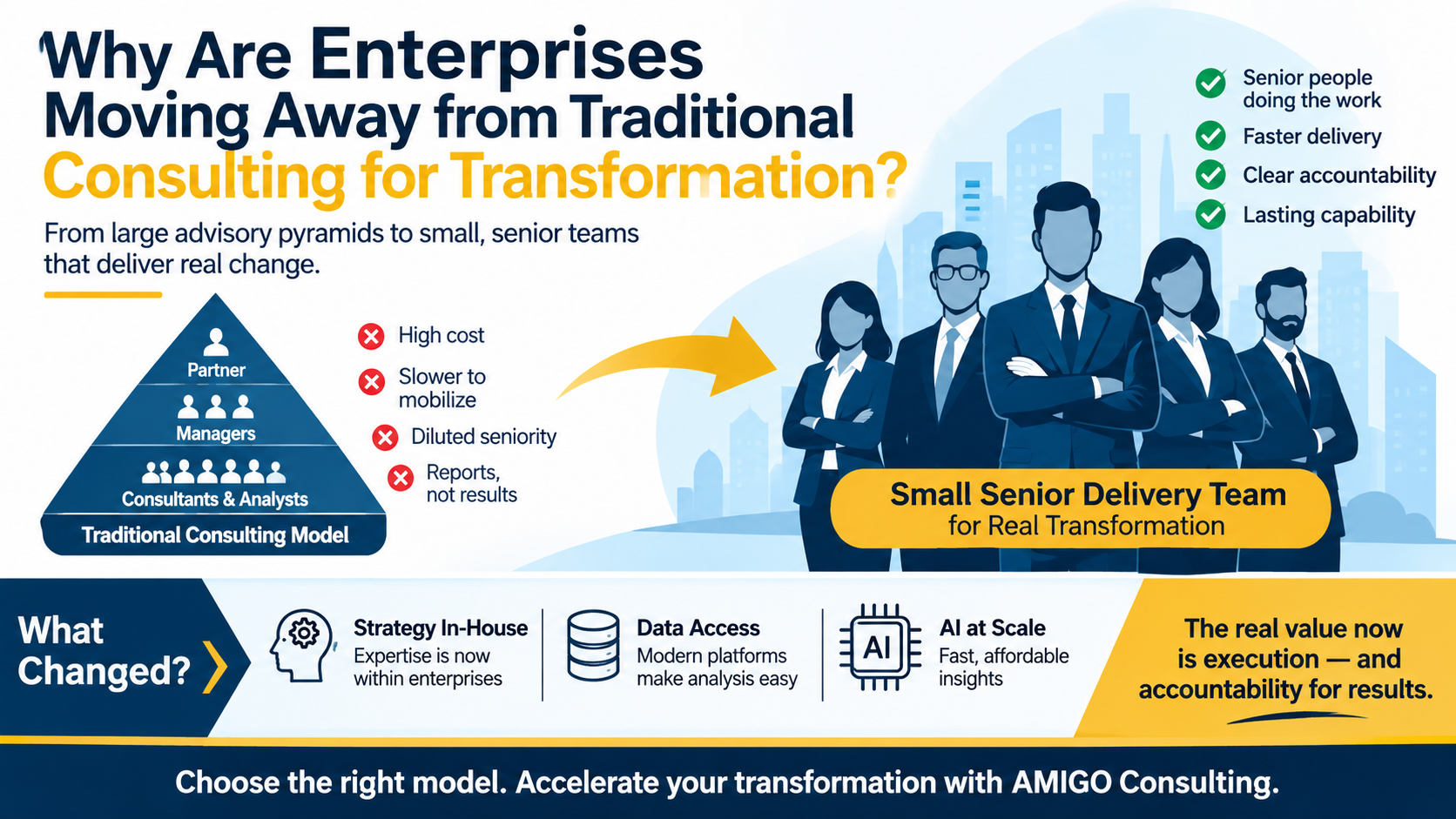
What changed in the consulting market?
Three things changed at the same time, and each one took value out of the analysis layer of consulting.
- Strategy moved in-house. Large companies have hired many former consultants into internal strategy, transformation and PMO roles. The skills that used to arrive with an outside team now sit on the payroll.
- Data became easier to reach. Modern ERP, cloud data platforms and self-service reporting let internal teams analyze their own operations without a six-week discovery phase.
- AI made analysis cheap and fast. Generative AI drafts market scans, benchmark summaries and first-pass business cases in hours. The output still needs judgment, but the cost of producing it has fallen sharply.
The effect is a change in what is scarce. Ten years ago, the hard part of a transformation was often deciding what to do. Today the hard part is landing it: the design decisions that must hold, the handoffs between teams and vendors, the data migration, the cutover and the adoption by the business.
The Movemeon Group, a talent marketplace for consulting and transformation professionals, reports the same direction in its October 2026 report Consulting into the new era: falling demand for analysis and synthesis work, and the fastest growth in embedded delivery roles. Movemeon draws on its own network, much of it in the UK, so its findings are best read as directional rather than as a market-wide measurement.
Is this shift showing up in the large firms' results?
The public numbers are worth reading plainly.
On June 18, 2026, Accenture reported fiscal third-quarter revenue of $18.7 billion, up 6% in reported terms and 3% in local currency. It lowered its full-year outlook to 3% to 4% local-currency growth, from 3% to 5%, and attributed part of that cut to its U.S. federal business. New bookings were $19.3 billion, against $19.7 billion a year earlier. Its shares fell about 18% that day, according to Quartz.
One quarter at one firm does not define a market, and there are many reasons a share price moves. A reasonable reading, though, is that investors are not questioning whether companies need transformation. They are questioning how much clients will keep paying for large billable teams to deliver it.
Why is analysis no longer the scarce part of a transformation?
Because the value of a transformation is created in execution, and execution depends on experience that cannot be generated on demand.
A recommendation to consolidate finance systems, redesign order-to-cash or move to SAP S/4HANA is now relatively easy to produce. What breaks programs is everything after the recommendation:
- Design decisions that stay open into build and test.
- Workstreams that each look healthy while the dependencies between them fail.
- Data that is not ready when the mock loads start.
- Status reports that stay green until the program is visibly red.
- A business that stops showing up for workshops and testing.
None of these is solved by more analysis. Each is solved by senior people who have seen the pattern before, act on it early and are accountable for the result.
What do enterprise buyers want instead?
Buyers are asking for four things more often than they used to:
- Senior people doing the work. Not a partner who sells and reviews while a junior team delivers. Buyers want the people in the proposal to be the people on the program.
- Speed. Senior practitioners are productive within days. A pyramid can take weeks to staff, onboard and bring up to speed.
- Clear accountability. One named lead who owns whether the change actually lands, not only whether the deliverables were produced.
- Capability that stays. A governance model, routines and know-how that the client's own team keeps and runs after the engagement ends.
How does a senior delivery model compare with a traditional consulting model?
| Factor | Traditional consulting pyramid | Small senior delivery team |
|---|---|---|
| Who sells the work | Partner or account lead | The people who will lead the work |
| Who does most of the work | Consultants and analysts, supervised by a manager | Experienced practitioners who have done the job before |
| Senior time on the program | Mostly reviews and steering meetings | Most of the working week |
| Time to productive work | Often weeks, while the team is staffed and onboarded | Usually days |
| Where it is strongest | Strategy, hard-to-reverse decisions, very large builds | Execution, governance, recovery, multi-vendor coordination |
| What the client keeps | Reports and recommendations | A working governance model and a team that can run it |
| Main risk | Seniority diluted as the program scales | Quality depends on the network the team is drawn from |
Neither model is right for every program. The point is to buy the model that matches the work in front of you, not the one you bought last time.
When is a traditional firm still the right choice?
A large firm still fits well in three situations:
- Decisions that are hard to reverse. A major acquisition, a portfolio overhaul or a board-level strategic bet benefits from a large firm's research depth and brand cover with the board.
- Builds that need hundreds of people at once. Some global rollouts need large delivery capacity across many countries and time zones, and a large integrator is built for that.
- Regulated or contractual requirements. Some programs require a specific firm, certification or contracting structure.
For the execution of most transformation programs, a senior, purpose-built team usually delivers more value per dollar. Many enterprises now combine the two: a large integrator for build capacity, with a small senior team providing governance and accountability over the whole program. For a closer look at the second model, see What Is a Custom Senior Transformation Team?.
How should a CIO rethink the next transformation proposal?
Use these questions before you sign any transformation proposal, whatever the size of the firm:
- Name the people who will work on the program each week, and confirm their availability in writing
- Count the senior days: how many days per week will experienced practitioners actually spend on your program?
- Meet the delivery lead before signing, and confirm that person will stay through go-live
- Identify the single person accountable for the outcome, not just for the deliverables
- Ask how status will be produced: from the work itself, or from slides assembled for the steering committee
- Ask how bad news reaches you, and how fast
- Agree what governance model, tools and know-how your team keeps when the engagement ends
- Check how the firm will work alongside your existing integrator and other vendors
- Separate the advisory work you need from the delivery work you need, and price them separately
A proposal that cannot answer these clearly is telling you something about how the program will run.
How does AMIGO Consulting fit this shift?
AMIGO Consulting builds a custom senior team for each client, sized to the program, from a few specialists up to about 50 people. The people who scope the work are the people who lead it. Every team runs on the AMIGO platform, a Salesforce-native governance system built on the AMIGA framework. The platform gives the client one governed view of scope, schedule, cost, risks and issues across governance, people, process, data, technology and value, for every workstream and every vendor.
We often work as the senior governance layer over the integrator a client already has, rather than replacing it. For how that works across several firms, see How Do You Keep a Transformation Accountable When Several Firms Are Delivering It?.