

Who this is for: Managing partners, founders and practice leads at boutique, specialist and Tier 3 consulting firms (roughly 5 to 500 people) in ERP, Salesforce, transformation and PMO work who want to bid for larger programs than they win today.
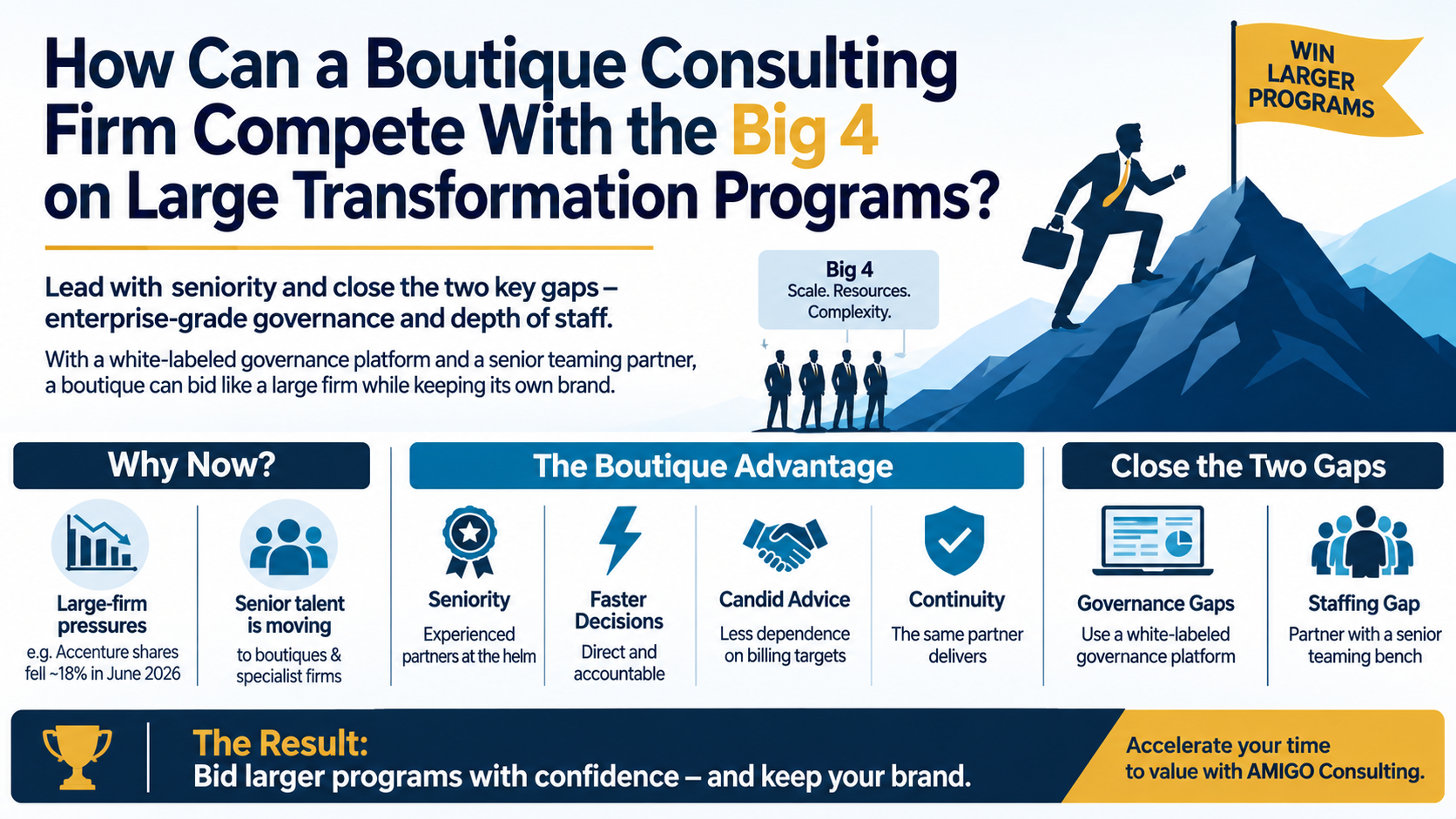
Why is this a good moment for boutique firms?
The large-firm model rests on leverage: a small number of partners sell and oversee the work, and a much larger pyramid of junior staff delivers it. That model is under pressure from two directions.
Investors are watching it closely. On June 18, 2026, Accenture's shares fell about 18% in a single day after the company cut its growth outlook, according to Quartz. A single trading day proves nothing on its own, but it shows how much attention the economics of large consulting firms now attract.
Talent is moving as well. The Movemeon Group's October 2026 report, Consulting into the new era, describes senior partners leaving large firms to build smaller, specialist practices. The result is that boutiques now hold a meaningful share of the senior people that enterprise clients most want on their programs.
For a founder-led firm, that is the opening. The question is not whether the market values senior delivery. It is whether a small firm can package that seniority in a way a large enterprise buyer will sign off on.
Why is seniority the product a boutique should sell?
Many enterprise buyers have experienced the gap between the people who sold the work and the people who delivered it. In a boutique, those are usually the same people. That is not a soft benefit. It changes how the program runs:
- Decisions happen faster because the person in the room can make them.
- Problems surface earlier because experienced practitioners recognize the warning signs from previous programs.
- Advice is more candid because senior people are less dependent on the next billing extension.
- Continuity is higher because the partner who sold the work has a personal stake in delivering it.
The mistake many boutiques make is treating seniority as a line in the proposal ("our team averages 20 years of experience") rather than as the core of the offer. Make it concrete and checkable:
| What you are selling | How to make it visible in a bid |
|---|---|
| The partner who sells does the work | Name the partner as program lead, with a committed share of their time |
| Experienced practitioners in every key seat | Name the people for each critical role and attach short CVs |
| Faster decisions | State who can approve staffing and commercial changes, and how fast |
| Fewer surprises | Show how risks, issues and value will be reported from week one |
| Continuity | Commit to key personnel and to client approval of any replacement |
Seniority wins the conversation. It does not, on its own, win a large program. For that, two more questions have to be answered.
Why do boutiques still lose large programs?
When a boutique loses a program it was well qualified to deliver, the cause is usually one of two gaps.
The governance gap. The client asks how a multi-workstream program will be governed, and the firm has no enterprise system to show. The honest answer is spreadsheets, slide decks and a strong program manager. That may work in practice, but it does not give a procurement team or a steering committee confidence that they will see problems before they become expensive.
The staffing gap. The program needs more people, or more kinds of specialist, than the firm can supply. A ten-person practice cannot credibly staff a program that needs thirty, and a firm strong in finance may have no cutover or testing lead to offer.
The Movemeon Group's report identifies the same two weak spots in the small senior-team model: a shallow network to draw on, and difficulty integrating several workstreams into one program. Both are fixable, and neither requires the firm to stop being a boutique.
How does a boutique close the governance gap?
Run every client program on a real governance platform, not a collection of documents. The platform should hold plans, risks, issues, decisions, earned value and benefits in one place, so status reports are produced from data rather than assembled the night before a steering committee.
Three things matter when a boutique chooses how to do this:
- It has to look like yours. A managing partner should not need to put another firm's logo in front of their client to appear enterprise-ready. A white-labeled platform carries the boutique's own name, logo and colors.
- It has to be used on every engagement. A platform shown in one proposal and abandoned on delivery fails the first time the client asks to see it. Standardize it across the practice so it becomes part of how the firm works.
- It has to show value, not just tasks. Large buyers care whether the program will deliver the business case. Earned value and benefits tracking let the firm report progress against cost and against promised benefits, not just completed activities.
The AMIGO Partner Program provides AMIGO, a Salesforce-native transformation governance platform built on the AMIGA framework, white-labeled under the partner firm's brand. Our article on answering the governance question in an enterprise RFP covers how to present this in a proposal.
How does a boutique close the staffing gap?
Hiring ahead of demand is risky for a small firm, and hiring after a win is usually too slow. The practical answer is a senior teaming bench: a partner firm that can supply experienced practitioners under the boutique's lead when a program needs depth.
What makes a teaming bench work for a boutique:
- Seniority that matches yours. If the bench supplies junior people, the boutique loses the very advantage it is selling. Ask for named, experienced practitioners in the roles you need.
- Your firm stays in charge. The boutique leads the program and owns the client relationship. Bench practitioners work under its direction.
- Terms agreed before the bid. Rates, roles and conditions should sit in a master services agreement signed in advance, so the firm can commit to a staffing plan in a proposal without negotiating under deadline.
- One governance system. When every practitioner reports through the same platform, the client sees one integrated team rather than several firms stitched together.
AMIGO Consulting supplies senior SAP, ERP, Salesforce, PMO, testing and cutover practitioners to partner firms on this basis. For detail on how small firms structure these arrangements with each other, see how small consulting firms team up to staff large programs.
Will a white-label platform and a teaming partner dilute our brand?
Not if the arrangement is built around the boutique. The test is simple: after the program, whose relationship is it? With a white-labeled platform and a teaming partner working under your lead, the answer should be yours.
Check these points before you commit to any partner:
- The client sees your firm's name on the governance platform, status reports and steering committee packs.
- Your firm holds the prime contract or the lead role in the client relationship.
- Rules for direct contact between the partner's people and your client are written down.
- The partner is open about where it also competes with you, and how that is handled.
The last point matters. Some partners also sell directly to clients. AMIGO Consulting does, and says so openly: partner firms and AMIGO Consulting are free to pursue the same client, and whoever wins can bring the other in to fill gaps. A partner that is candid about competition is easier to plan around than one that is not.
Can we bid this program? A pre-bid checklist
Before declining a large program, test whether the gaps are real or fixable:
- We can name a senior lead for the program from our own partners
- We can show the client a working governance platform under our brand, not a methodology slide
- We can report earned value and benefits against the business case from the first month
- We have mapped every critical role and know which ones we cannot staff ourselves
- We have a teaming partner with senior people in those roles and terms already agreed
- Our proposal shows one integrated team with one reporting line to the client
- We know whether the client tracks diverse-supplier spend, and whether that matters for this bid
- We have a fallback if the program goes sideways, such as an independent quality assurance assessment and replan
If most of these boxes can be ticked, the firm can likely bid. If the gaps are in governance or headcount, they can usually be closed before the RFP deadline.