
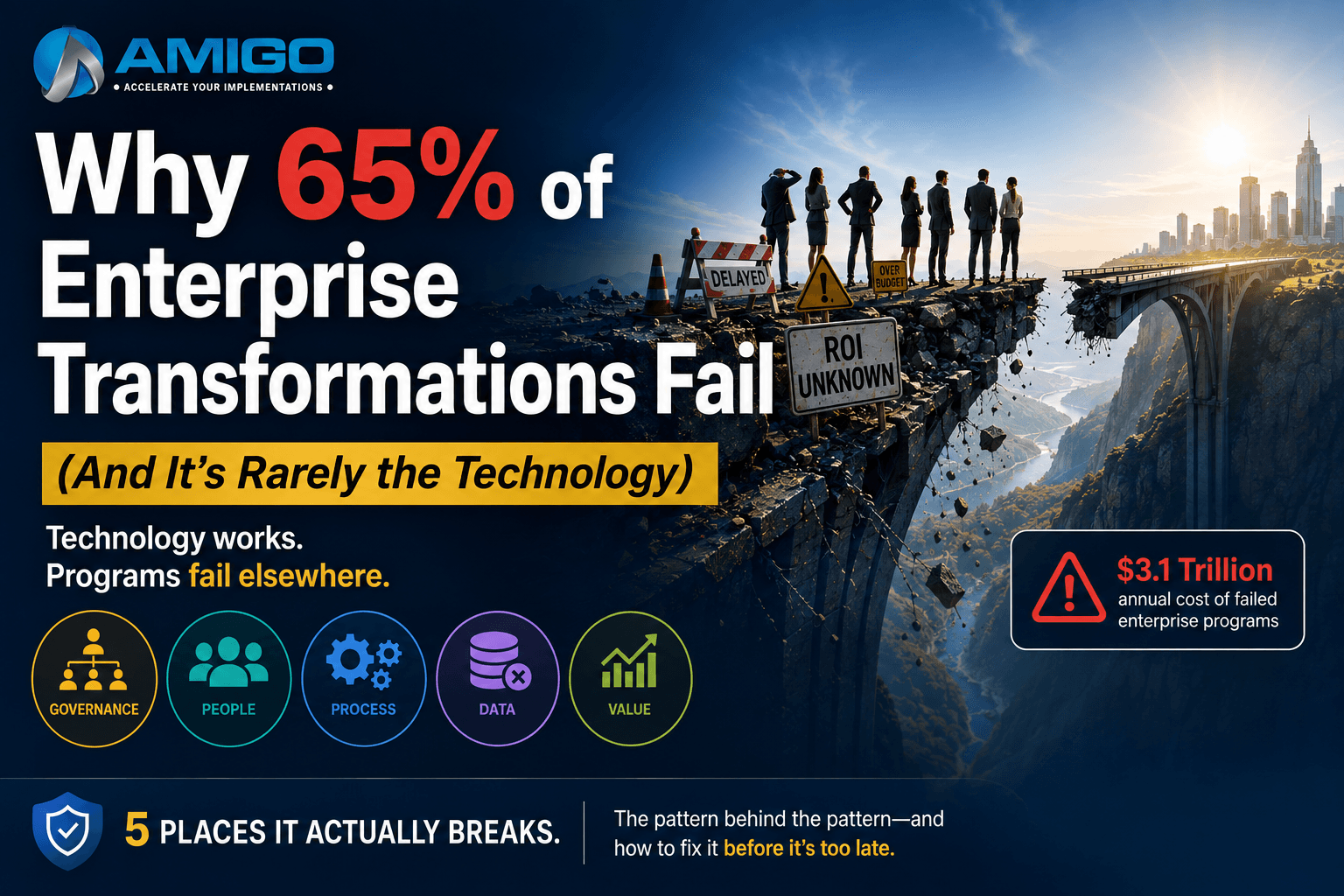
Every year, organizations pour billions into ERP rollouts, Salesforce migrations, and digital transformation programs. Most of that money doesn't come back as promised. Industry estimates put the annual cost of failed enterprise programs at $3.1 trillion — and the technology is almost never the reason.
We've run seven- to nine-figure programs across manufacturing, healthcare, financial services, and distribution for over 30 years. In every failure we've seen, the pattern is the same: the software works fine. The program collapses somewhere else.
Here are the five places it actually breaks.
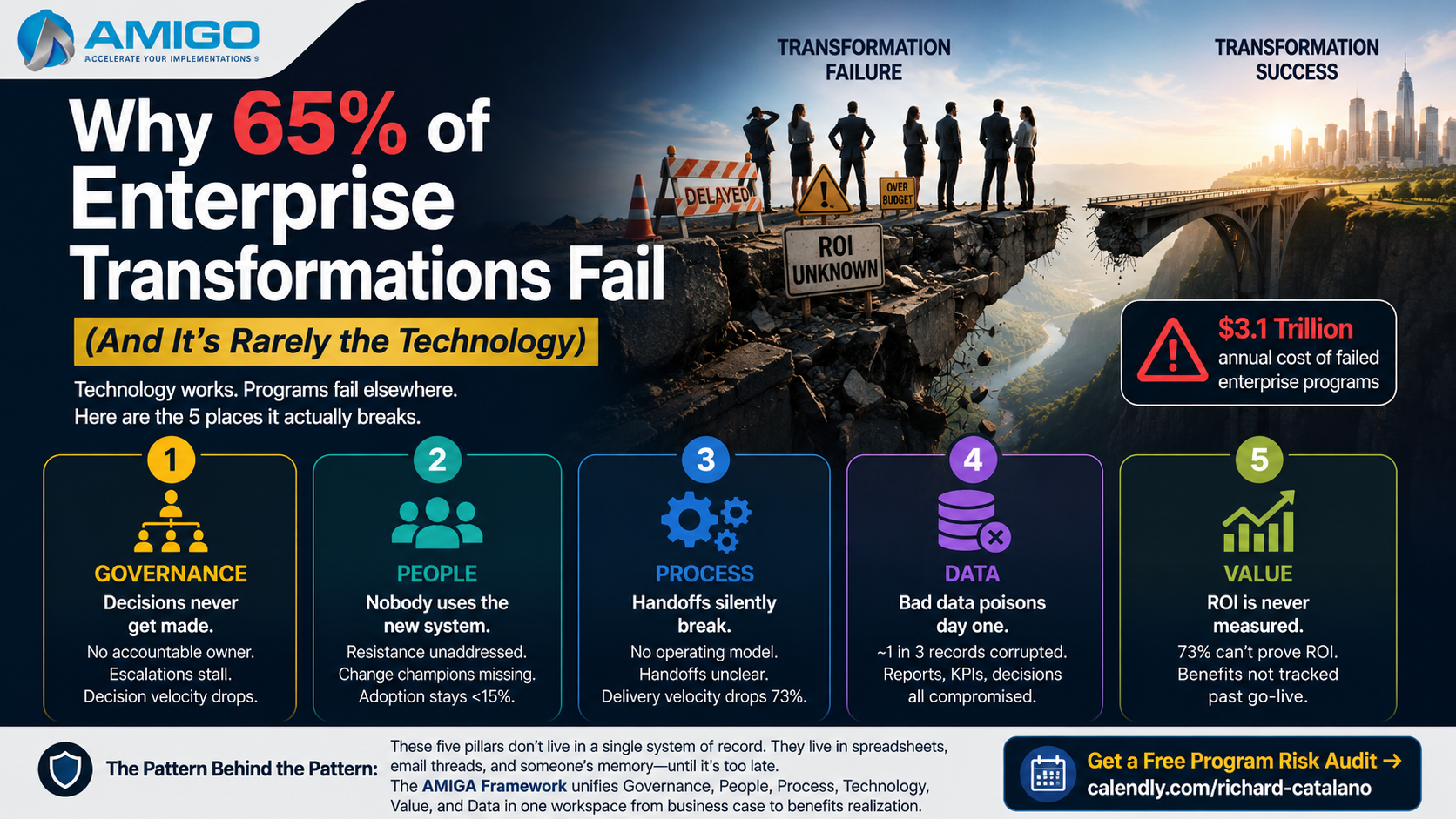
1. Governance: Decisions never get made
Programs don't usually die in a dramatic blowup. They die slowly, in the two-week gap between "we need a decision" and "someone actually made it." No single accountable owner. Escalations that go into a queue and never come back out. By the time leadership notices, decision velocity has dropped 40% and the schedule is already unrecoverable.
The fix isn't more meetings. It's clear decision rights, a documented RAID log, and phase gates that actually gate something — before day one, not after the first slip.
2. People: Nobody uses the new system
This is the one that blindsides finance the most, because it shows up after go-live, after the budget is spent. The system is live, the data migrated, the training delivered — and adoption sits under 15%. Not because the tool is bad, but because nobody mapped resistance, built change champions, or gave people a reason to abandon the workaround they already trust.
Change management isn't a workstream you bolt on in month nine. It has to run parallel to technical delivery from kickoff.
3. Process: Handoffs silently break
Without a codified operating model, teams optimize their own piece of the process and leave everyone downstream to figure it out. Delivery velocity can drop 73% not because anyone is underperforming, but because nobody owns the seams between teams. RACI clarity sounds boring until you watch a program without it.
4. Data: Bad data poisons day one
Roughly one in three migrated records ends up corrupted in a typical enterprise migration. Garbage data doesn't just create a cleanup task — it corrupts every report, every KPI, and every decision built on top of the new system from day one. Master data governance and reconciliation rules aren't a "nice to have" for the data team; they're the foundation the other four pillars stand on.
5. Value: ROI is never measured
73% of organizations can't prove the ROI of their transformation. Not because the value wasn't real, but because nobody tracked benefits realization past go-live. The business case gets written once, filed, and forgotten. Eighteen months later, nobody can say whether the program delivered what it promised — including the people who approved the budget.
The pattern underneath the pattern
Governance, People, Process, Data, and Value all fail for the same underlying reason: they're the parts of a transformation that don't live in a single system of record. They live in spreadsheets, email threads, and someone's memory. Technology gets a dedicated tool. These five don't — until the program is already in trouble and someone builds a tracker to catch up.
That's the gap the AMIGA Framework was built to close: six pillars — Governance, People, Process, Technology, Value, and Data — in one workspace, instrumented from business case through benefits realization, not stitched together after the fact.
If your program is already underway and one of these five patterns sounds familiar, it's worth a diagnostic conversation before the next gate review, not after.