
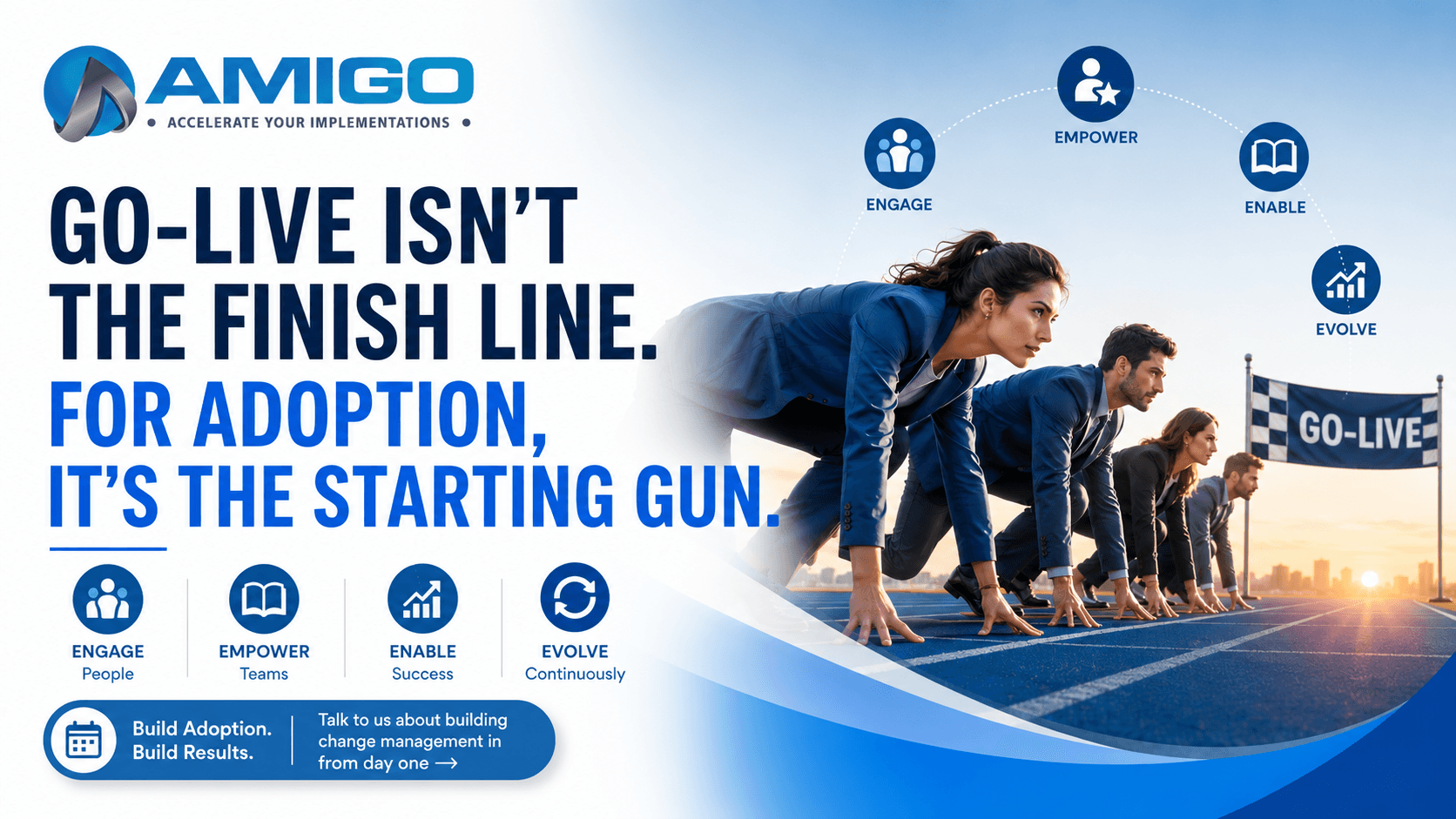
Go-Live Isn't the Finish Line. For Adoption, It's the Starting Gun.
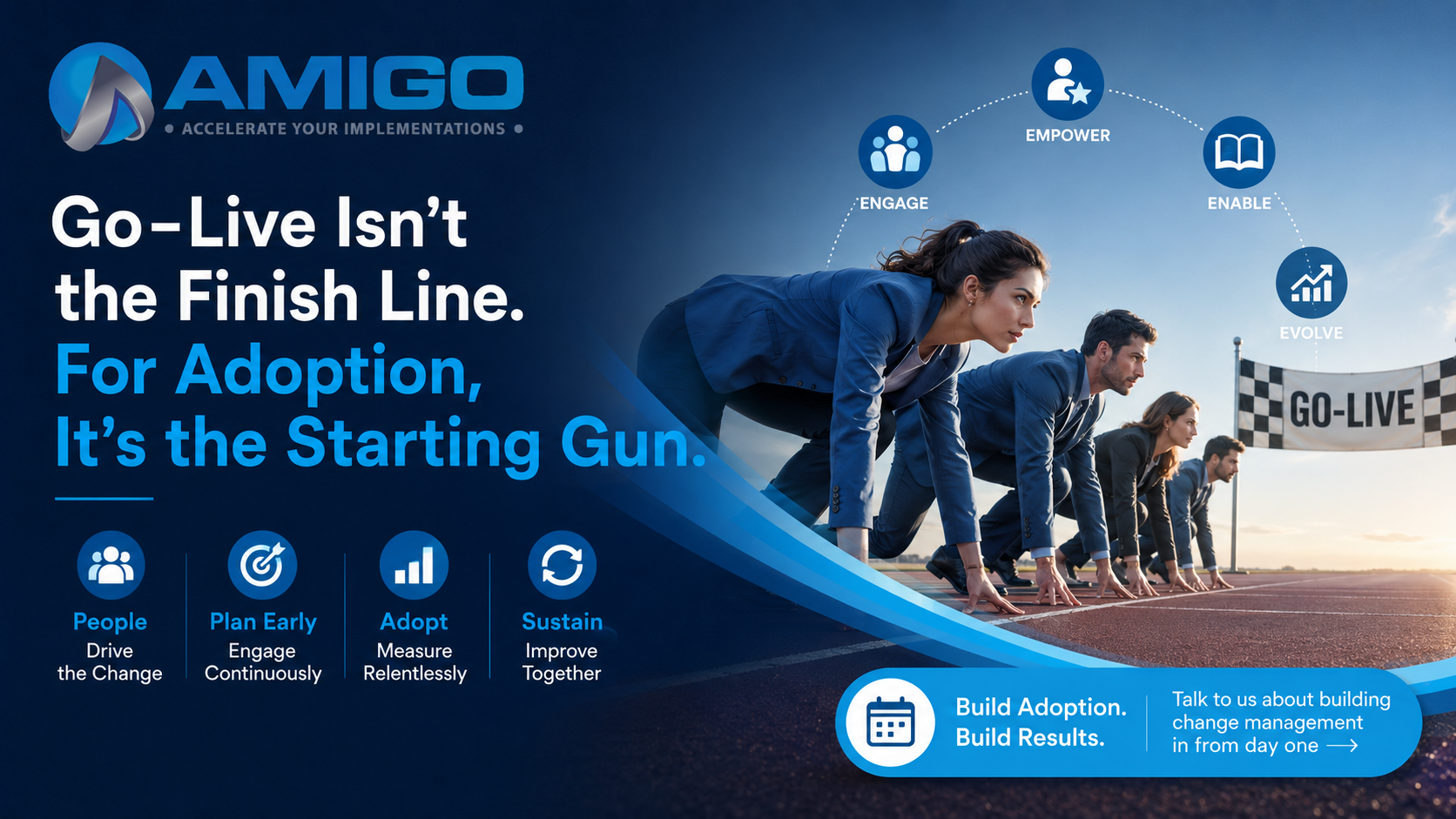
Most transformation programs treat go-live as the finale. The system is deployed, the migration is done, the steering committee gets a victory slide. Then, three months later, someone pulls the usage report and finds adoption sitting at 15%. Everyone is still running the old spreadsheet next to the new system, "just to be safe."
This isn't a technology failure. The software works exactly as designed. It's a people failure and it was baked in months before go-live, not caused by it.
Adoption doesn't fail at launch. It fails in the planning gap.
The pattern is consistent across manufacturing, healthcare, and financial services programs alike: change management gets scoped as a workstream that runs after the technical build, instead of parallel to it. Training gets scheduled for the two weeks before go-live. Communications start when the system is already close to done. By the time end users hear about the change, the decisions that affect their day-to-day work were made without them.
By the time anyone notices adoption is low, the program team has moved on to the next phase, the budget line for change management has closed, and the org is left with a system nobody trusts enough to abandon their old process.
What actually drives adoption
Resistance mapping, early. Not every team resists change the same way or for the same reason. A finance team worried about losing a familiar close process needs a different intervention than an ops team worried about losing tribal knowledge embedded in a spreadsheet. Generic "here's what's changing" communications don't move either group.
Champions embedded in the team, not parachuted in. The programs that hit strong adoption numbers almost always have a peer someone the team already trusts fielding questions in real time, not a program office resource who shows up for a scheduled session and leaves.
Training tied to the actual job, not the generic workflow. A/P clerks don't need to understand the whole system. They need to understand the four screens they'll touch every day. Broad, one-size-fits-all training sessions burn budget and still leave people unprepared for their specific tasks.
Feedback loops that don't stop at go-live. Adoption isn't a single measurement taken 30 days after launch. It's a trend line. Programs that track usage weekly for the first two quarters catch a stalling adoption curve while there's still time to intervene — a coaching session, a workflow tweak, a follow-up communication. Programs that check once, three months out, catch it only after the workaround habits have hardened.
The real cost of getting this wrong
Low adoption doesn't just waste the software budget. It undermines the entire business case the transformation was built on. If half the finance team is still reconciling in the old spreadsheet, the new system's data isn't complete, which means the reporting isn't reliable, which means the ROI the program promised leadership was based on partial usage from day one.
Change management isn't the "soft" part of a transformation program. It's the part that determines whether the other four pillars governance, process, data, and value actually get realized in practice, or just on paper.
If your program is heading toward go-live and change management is still scoped as a post-launch activity, that's worth revisiting before the schedule locks it in.
Talk to us about building change management in from day one →