
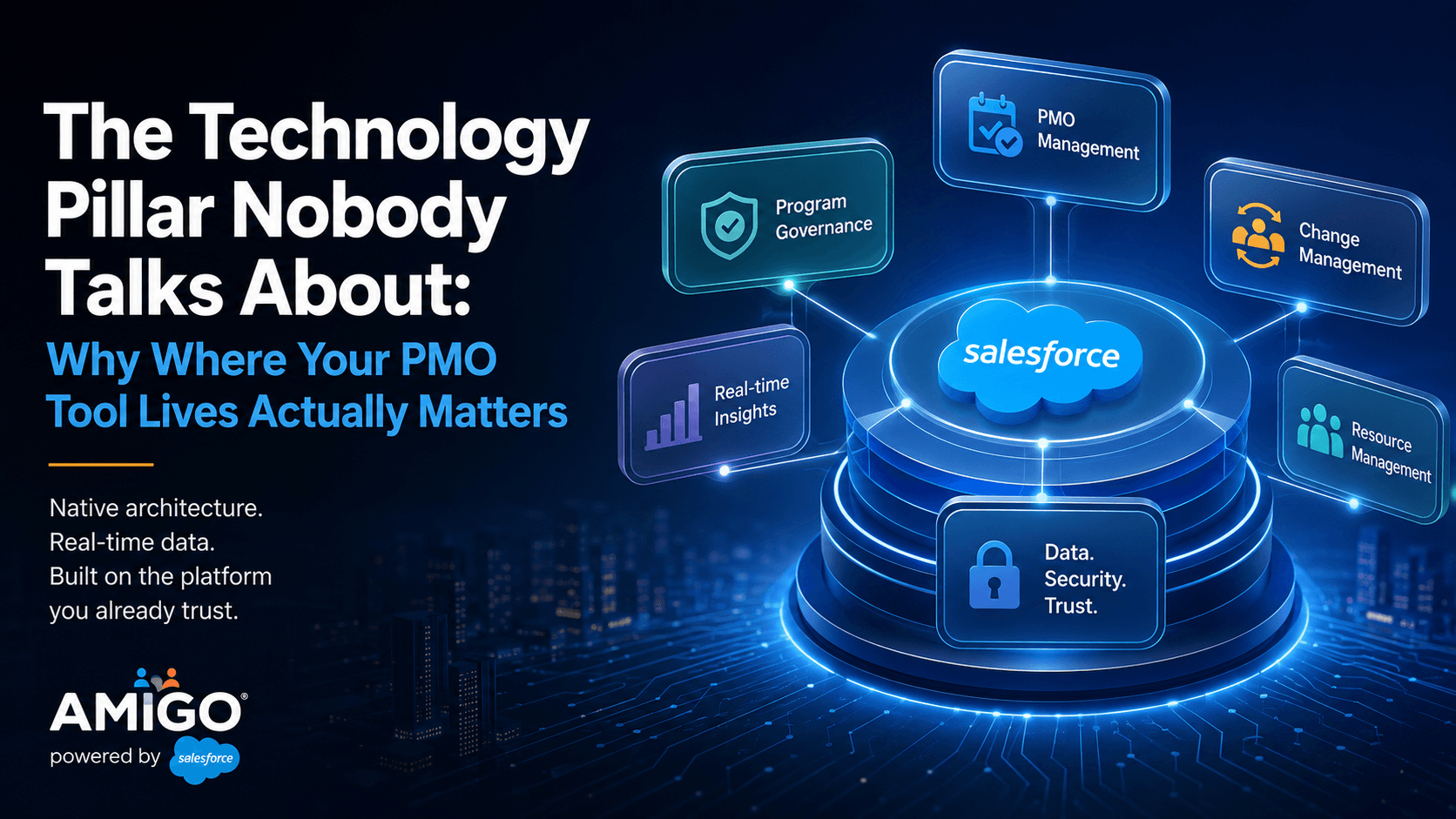
Most conversations about transformation platforms focus on features — dashboards, reporting, AI capabilities. Almost nobody asks the more basic question: where does this tool actually live, architecturally, relative to everything else running the business?
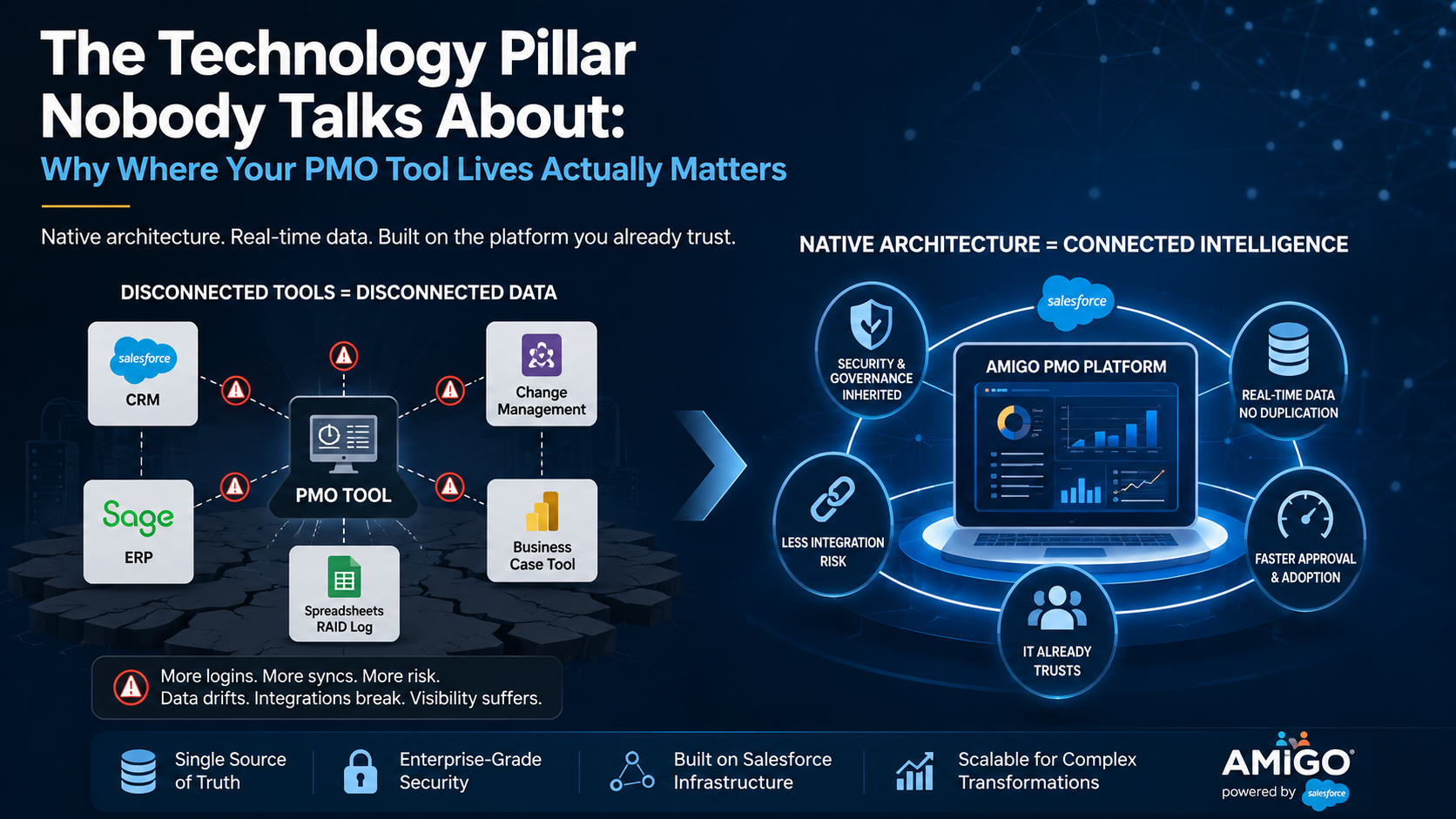
That question matters more than it sounds. A PMO tool that's a standalone system, disconnected from the CRM, the ERP, and the rest of the enterprise stack, creates the exact same fragmentation problem it was supposed to solve — just one layer up.
The point-solution trap
Enterprise programs already juggle a scattered stack by default: a scheduling tool, a separate change-management system, a spreadsheet for the RAID log, a different platform entirely for the business case. Each tool is reasonable on its own. The fragmentation isn't in any single choice — it's in the sum of all of them, and in the manual reconciliation work that falls on the program team to keep it all roughly in sync.
Adding a PMO platform on top of that stack, as one more disconnected system, doesn't fix the fragmentation. It adds a layer to it — one more login, one more place data can drift out of sync with everything else, one more integration someone has to maintain.
Why native architecture changes the equation
A platform built natively on infrastructure the enterprise already runs — rather than integrated after the fact through APIs and middleware — behaves differently in a few concrete ways:
Data doesn't need to be synced, because it's not duplicated. Native architecture means program data lives in the same data model as the rest of the business, not a shadow copy that has to be reconciled on a schedule and inevitably drifts.
Security and governance inherit from the platform, not from a separate configuration. Enterprise IT teams already have security models, permission structures, and compliance controls built into their core platform. A native tool inherits those automatically. A bolted-on tool requires a parallel security setup that someone has to build, maintain, and audit separately.
Integration risk drops because there's less to integrate. Every API connection between systems is a place things can silently break — a field mapping that gets out of sync after a platform update, an integration that fails quietly over a holiday weekend. Fewer connections means fewer places for that kind of failure to hide.
IT already trusts the platform. Getting a new standalone tool through security review, procurement, and IT approval is its own multi-month process. A native extension of infrastructure IT already vets and trusts moves through that process faster, because the platform-level trust already exists.
What this means in practice for a transformation program
None of this is about a specific vendor preference for its own sake. It's about what happens when program management, change tracking, and governance live in the same architecture as the systems of record they're actually managing change for — versus living next to them, connected by a web of integrations that all have to keep working.
A Salesforce-native architecture, for example, means program data, CRM data, and case data can reference each other directly, without a middleware layer translating between two separate data models. For programs where Salesforce is already the system of record for customer and case data, that's not a minor convenience — it's the difference between governance data that's always current and governance data that's accurate as of the last successful sync.
The question worth asking before evaluating features
Before comparing dashboards and AI capabilities across PMO platforms, it's worth asking a more foundational question: does this tool live inside infrastructure my organization already trusts, or does it add a new island that has to be connected, secured, and maintained on its own?
The features matter. But architecture is what determines whether those features stay reliable six months after rollout, once the initial implementation excitement wears off and the integration has to run unattended.