
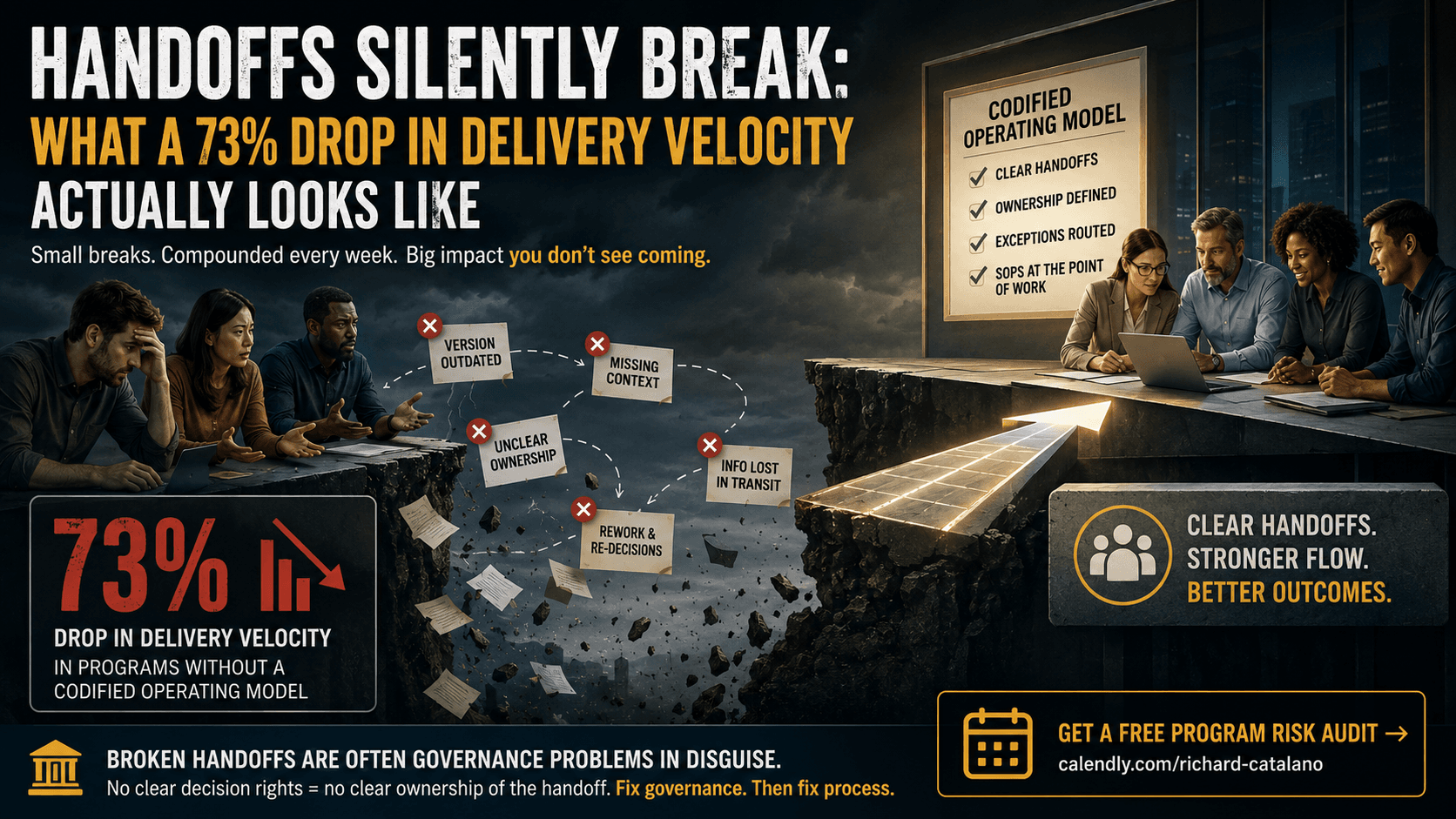
Nobody schedules a meeting to announce that a handoff has broken. It just happens — a design decision made by one workstream doesn't reach the team building the next dependent piece, or reaches them a week late, or reaches them in a version that's already been revised twice more since. By the time anyone notices, the delay has already compounded.
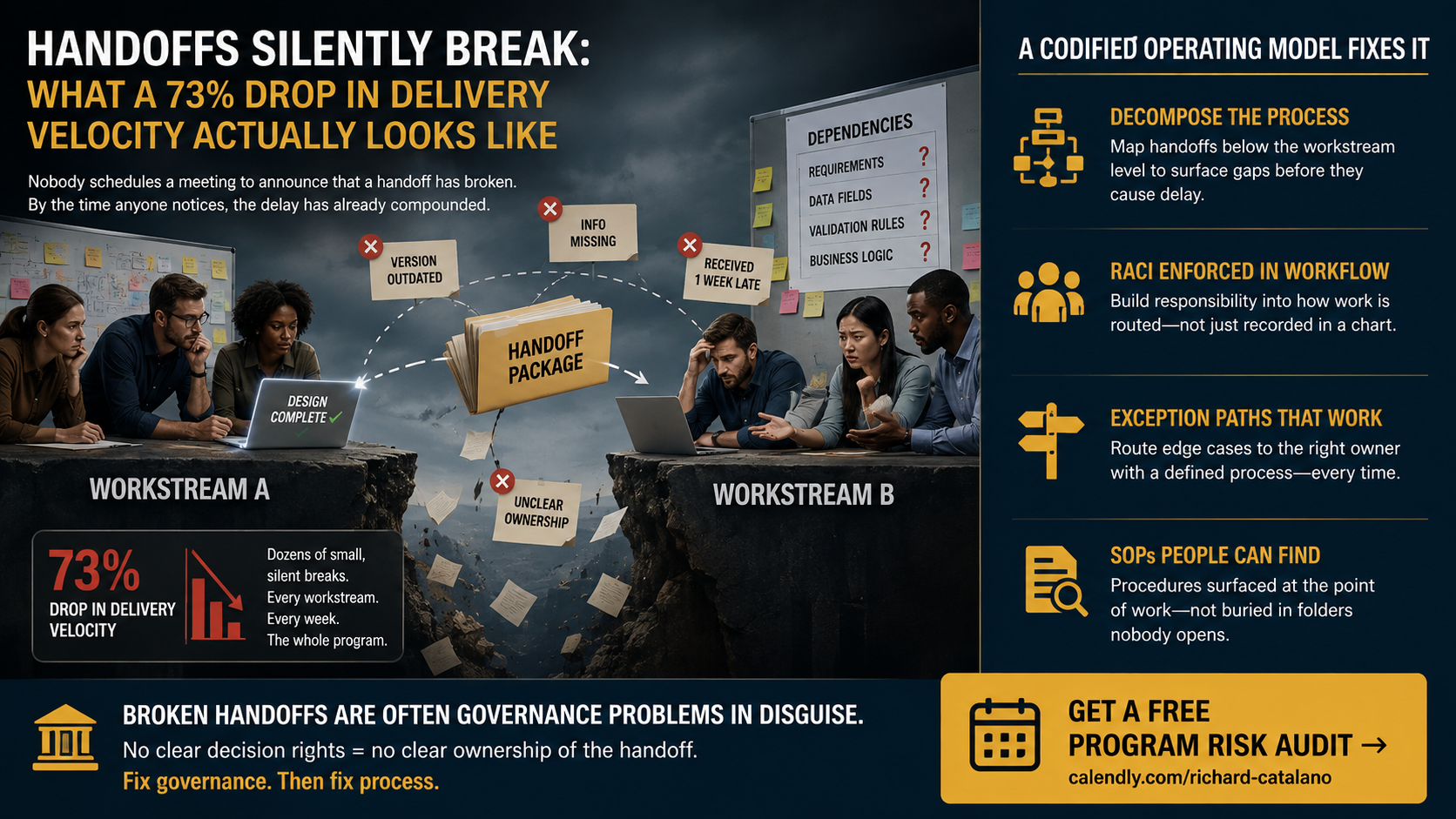
Programs without a codified operating model can see delivery velocity drop 73%. That number doesn't come from one dramatic failure. It comes from dozens of small, silent breaks in the handoffs between teams, repeated across every workstream, every week, for the life of the program.
Why handoffs break even when everyone is working hard
Ownership is assumed, not documented. Most teams have a rough sense of who owns what. Rough is the problem. When a decision sits at the edge of two teams' responsibilities, "rough sense" turns into both teams assuming the other one is handling it — and nobody handling it.
RACI exists on paper but not in practice. Plenty of programs have a RACI chart somewhere in a kickoff deck. Far fewer actually use it day-to-day to route decisions and unblock work. A RACI that lives in a slide from month one and never gets referenced again isn't governance — it's documentation of an intention.
Teams optimize their own workstream, not the whole flow. This isn't a failure of individual effort. It's what happens by default when nobody owns the seams between teams. Each team hits their own milestones and considers their piece done — even when what they handed off isn't quite what the next team needed.
Exceptions have nowhere to go. Every process has edge cases that don't fit the standard flow. Without a defined path for exceptions, they either get stuck waiting for someone to notice, or get resolved ad hoc by whoever's available — which means the same exception gets solved differently every time it recurs.
What a codified operating model actually fixes
Process decomposition that goes below the workstream level. Mapping a process down to the individual handoff points — not just "Finance workstream" and "IT workstream," but the specific moment data or a decision moves from one to the other — is what surfaces the gaps before they cause a delay.
RACI enforced in the workflow, not just documented. When responsibility is built into how work actually gets routed — not just recorded in a chart — ambiguity about who owns a decision stops being a recurring question.
Exception handling with an actual path. A defined process for routing edge cases to the right owner, instead of leaving them to whoever happens to be available, keeps exceptions from becoming inconsistent one-off judgment calls.
An operating procedure library people can actually find. SOPs that live in a shared drive nobody browses might as well not exist. The ones that get followed are the ones surfaced at the point of work, not buried three folders deep.
The pattern connects back to governance
Process breakdowns rarely happen in isolation. A broken handoff is often a governance problem wearing a process costume — no clear decision rights means no clear ownership of the handoff in the first place. Fixing process without fixing governance tends to produce a cleaner-looking RACI chart that still doesn't get followed.
If your program is seeing deadlines slip without an obvious single cause, it's worth mapping the actual handoffs — not the workstreams — before assuming it's a resourcing problem.