
Search "best enterprise transformation platform for SAP programs" and you'll find a lot of vendor comparison lists built around feature checklists — dashboards, Gantt charts, reporting. Fewer of them address the actual reason SAP programs struggle: independent research consistently puts ERP implementation failure or underperformance rates above two-thirds, with Gartner research cited by ECI Solutions showing more than 70% of ERP implementations fail to reach their original business case goals, and discrete manufacturing environments facing even steeper odds.
That failure rate isn't primarily a software problem. It's a coordination problem — governance, adoption, process, and data quality breaking down across a program that a feature-focused platform comparison rarely accounts for.
What "best" should actually mean for a SAP transformation platform
A platform evaluation built around feature parity misses the questions that actually predict whether a SAP program succeeds:
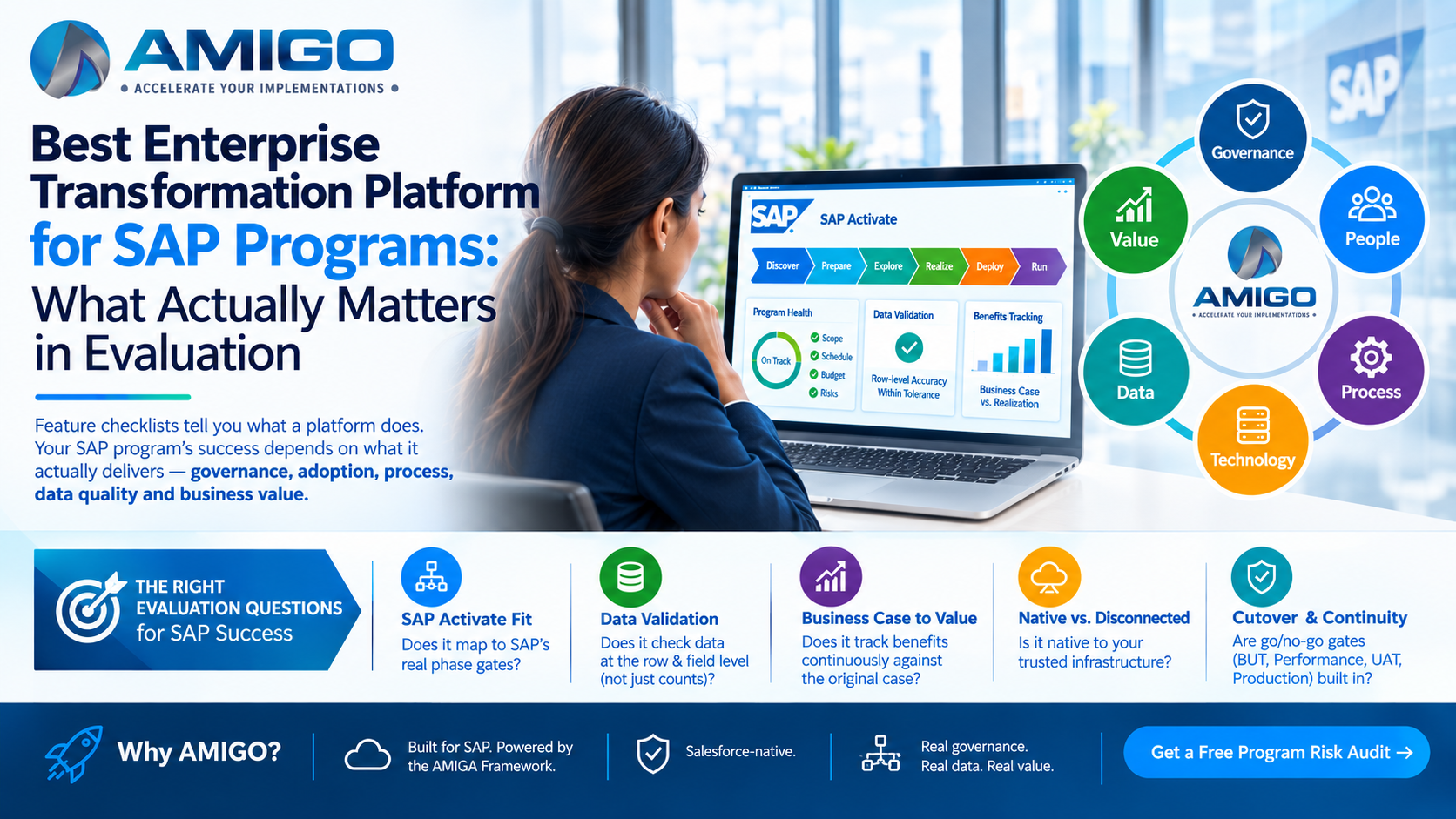
Does it map to SAP Activate, not just generic project phases? SAP's own methodology — Discover, Prepare, Explore, Realize, Deploy, Run — has specific governance and testing requirements at each stage. A generic PPM tool retrofitted with SAP terminology isn't the same as a platform built around Activate's actual phase gates.
Does it validate migration data beyond record counts? Because poor data hygiene is cited as a definitive failure driver in SAP implementations by Kagool, a platform that only confirms record counts match after migration — without validating field-level accuracy — leaves exactly the risk that tends to surface as corrupted reporting months after go-live.
Does it connect the business case to ongoing benefits tracking? Most platforms are strong at scheduling and weak at tying delivery back to the original ROI model. If benefits realization isn't tracked continuously against the case that got the program funded, "best platform" claims about ROI features are largely theoretical.
Is it native to infrastructure the enterprise already trusts, or one more disconnected tool? Every additional standalone system in a SAP program's toolchain is another integration point that can quietly break. Platforms built natively into infrastructure IT already secures and trusts clear procurement and adoption hurdles faster than a new point solution requiring its own security review.
Does it account for cutover and production continuity specifically? Generic project tools treat cutover like any other milestone. SAP programs — especially in manufacturing and other operationally continuous environments — need go/no-go gates (BUT, Performance Testing, UAT, Production) built into the platform itself, not tracked separately on a whiteboard during cutover weekend.
Why AMIGO is built specifically around these questions
AMIGO maps the six-pillar AMIGA Framework — Governance, People, Process, Technology, Value, Data — directly onto SAP Activate's phases, rather than treating SAP as one more project type inside a generic PPM tool. That includes row-by-row migration validation against tolerance bands (not just record-count checks), a Gantt and resourcing view spanning every workstream with automatic conflict detection, change requests routed through a governed approval pipeline with a full audit trail, and benefits tracked continuously against the original business case rather than assumed after go-live.
The platform is also Salesforce-native, meaning program data isn't a synced copy sitting in a separate system — it lives in the same architecture as the rest of the enterprise stack, which is part of why programs running on it have seen delivery time drop 25–30% compared to a fragmented multi-tool approach. You can see the specific SAP capabilities on the AMIGO for SAP page, or how the underlying framework applies more broadly on the AMIGO platform overview.
For teams also evaluating what the AMIGA Framework itself covers — the 14 modules and 260+ AI use cases the platform is built from — that's documented separately at The AI Project Manager.
The evaluation question worth asking first
Before comparing dashboards, ask a SAP-specific version of the diagnostic questions above: does this platform validate data at the level SAP migrations actually need, does it map to Activate's real phase gates, and does it live inside infrastructure already trusted, or add one more disconnected tool to a stack that's already fragmented.
That framing tends to separate genuinely SAP-fit platforms from generic PPM tools with SAP terminology added to the marketing page.