
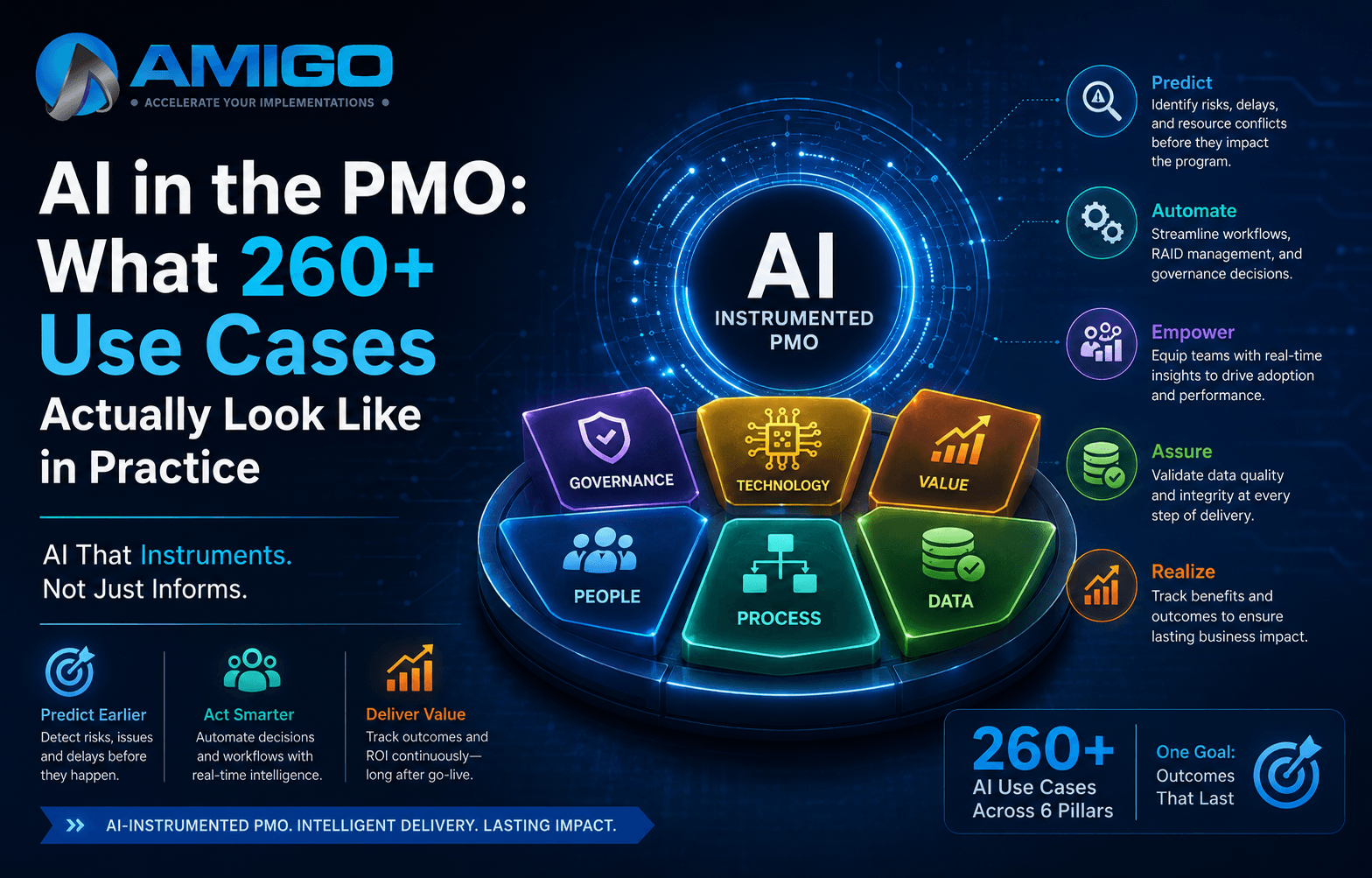
"AI-powered PMO" has become one of those phrases that means everything and nothing. A chatbot bolted onto a status report counts. So does an actual predictive model flagging a schedule slip three weeks before anyone notices. The label doesn't tell you which one you're getting.
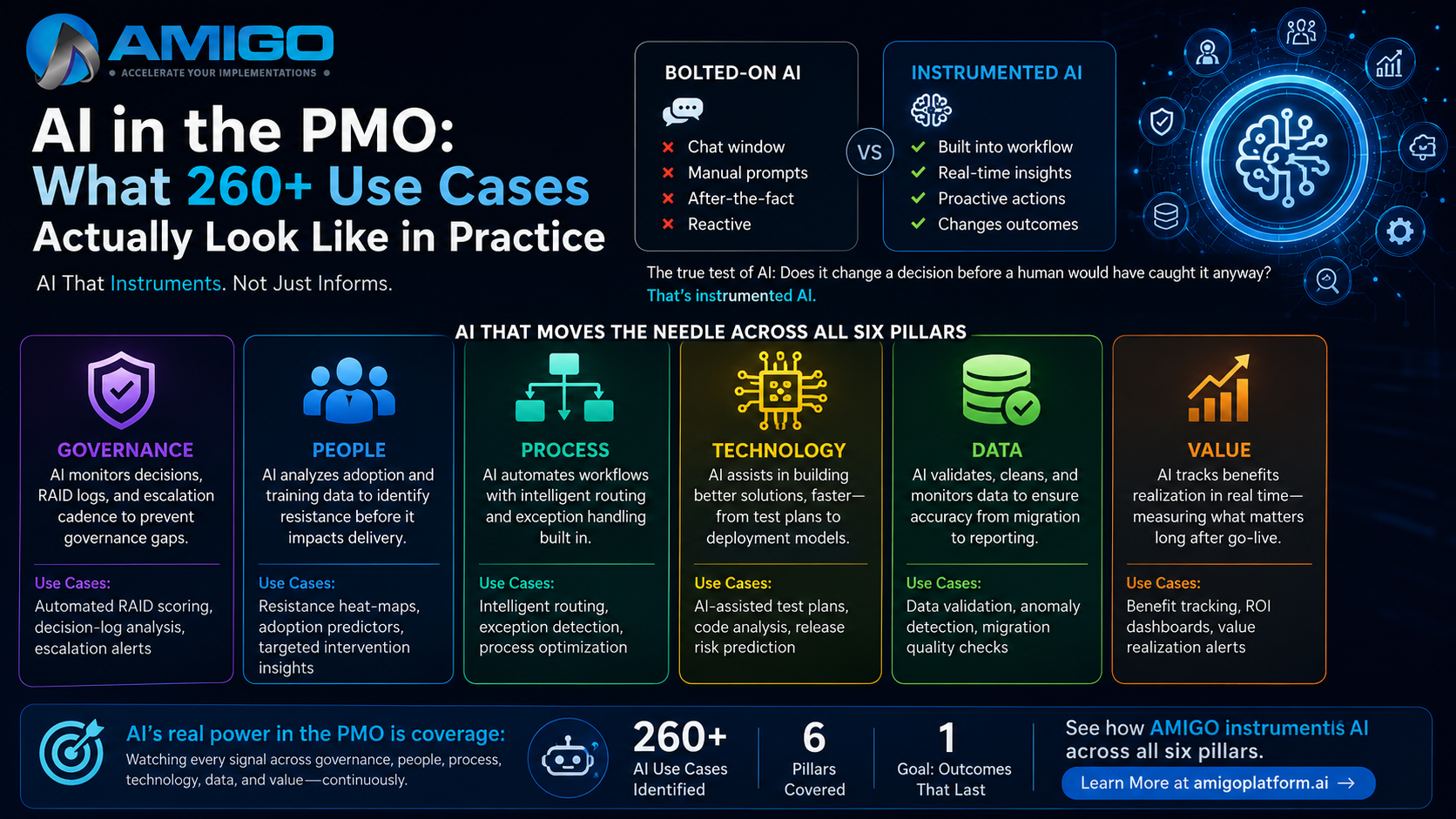
After mapping AI use cases across every pillar of enterprise transformation — governance, people, process, technology, data, and value — a few patterns emerge about where AI actually earns its place in program delivery, and where it's just a badge on the pricing page.
The difference between "AI-powered" and AI-instrumented
Most PPM tools added a copilot after the fact: ask it a question, get a summary, move on. That's useful, but it's not instrumentation — it's a chat window sitting next to the same manual process.
Instrumented AI is different. It's built into the workflow itself, not alongside it:
- Real-time risk detection that watches RAID logs and decision cadence, not a quarterly report someone has to remember to run
- Predictive analytics on schedule and resource conflicts, surfaced before they become the Friday afternoon fire drill
- Automated governance — change requests scored and routed on submission, not triaged three days later in a standing meeting
The test for whether AI is instrumented or bolted-on is simple: does it change what happens before a human looks at the dashboard, or only what a human sees after they ask?
Where AI actually moves the needle across the six pillars
Governance — Automated RAID scoring and decision-log analysis that flags when an escalation has been sitting too long, before it becomes a two-week stall.
People — Resistance heat-mapping built from adoption metrics and training completion, so change managers know which teams need intervention before go-live, not after usage data comes in flat.
Process — Workflow automation with exception handling that routes edge cases to a human instead of quietly breaking the handoff.
Technology — AI-assisted test plan generation, drafted directly from design artifacts so QA teams review and adjust instead of building test cases from a blank page.
Data — Row-by-row validation against tolerance bands during migration, catching the one-in-three corrupted records before they poison a live system.
Value — Live benefit-realization tracking against the original business case, so ROI is measured continuously for years post go-live instead of assumed and forgotten.
None of these are flashy. They're not "AI writes your project plan for you." They're AI doing the tedious, error-prone monitoring work that used to fall through the cracks between status meetings — which is exactly where transformation programs actually break.
Why this matters for the PMO, specifically
A PMO's real job isn't producing status reports. It's catching the thing that's about to go wrong before it does. That requires watching hundreds of signals across governance, people, process, data, technology, and value simultaneously — something no PMO, however well-staffed, can do manually at program scale.
That's the argument for AI in program delivery that has nothing to do with hype: it's coverage. A well-instrumented platform can watch every pillar, continuously, in a way a quarterly steering committee review never could.
If you're evaluating what "AI-powered" actually means in a platform you're considering, the question worth asking isn't "does it have AI." It's "does the AI change a decision before a human would have caught it anyway." Everything else is a chat window.