
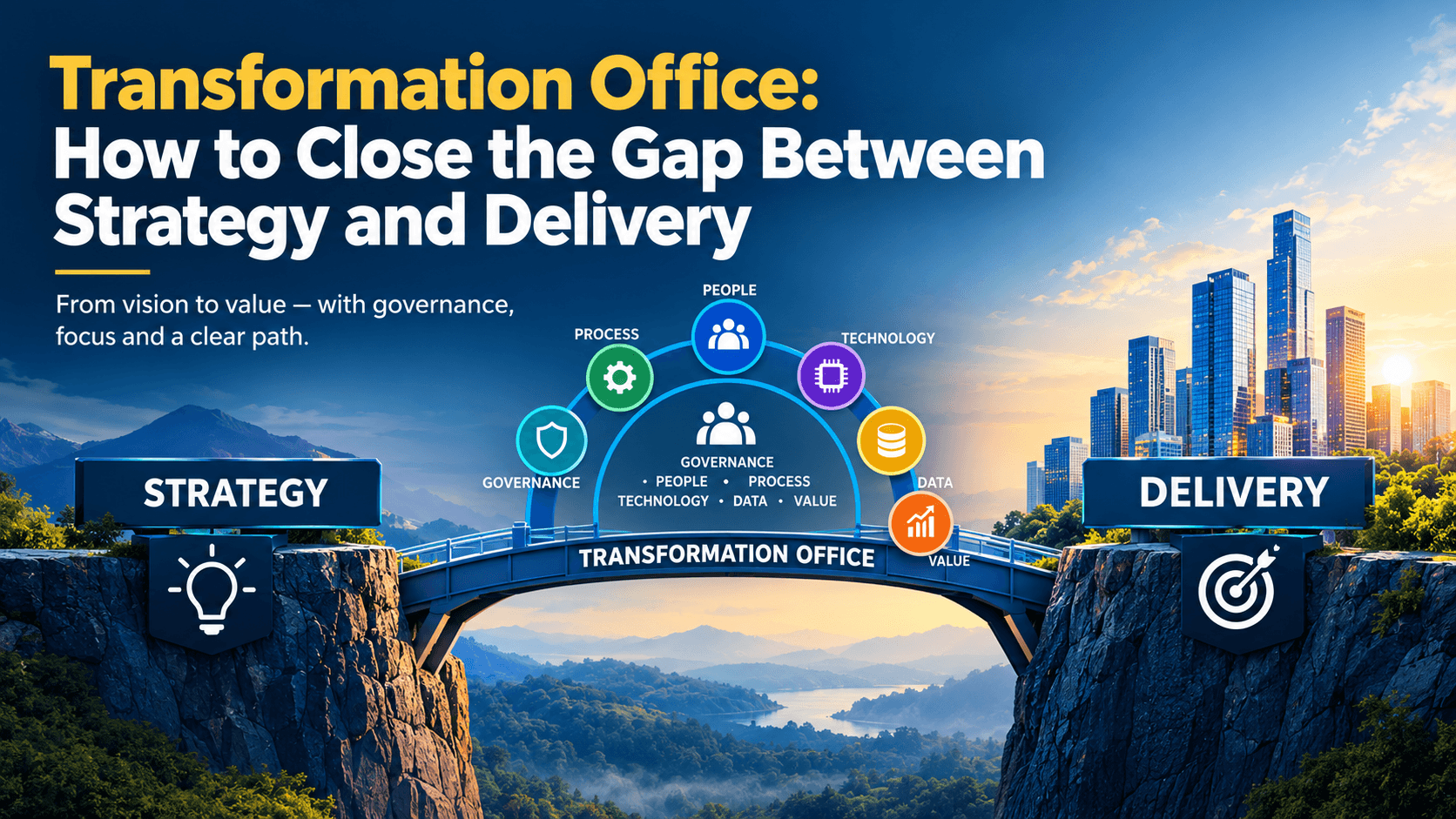
Strategy decks are easy. Delivery is where value leaks out. A transformation office exists to stop that leak.
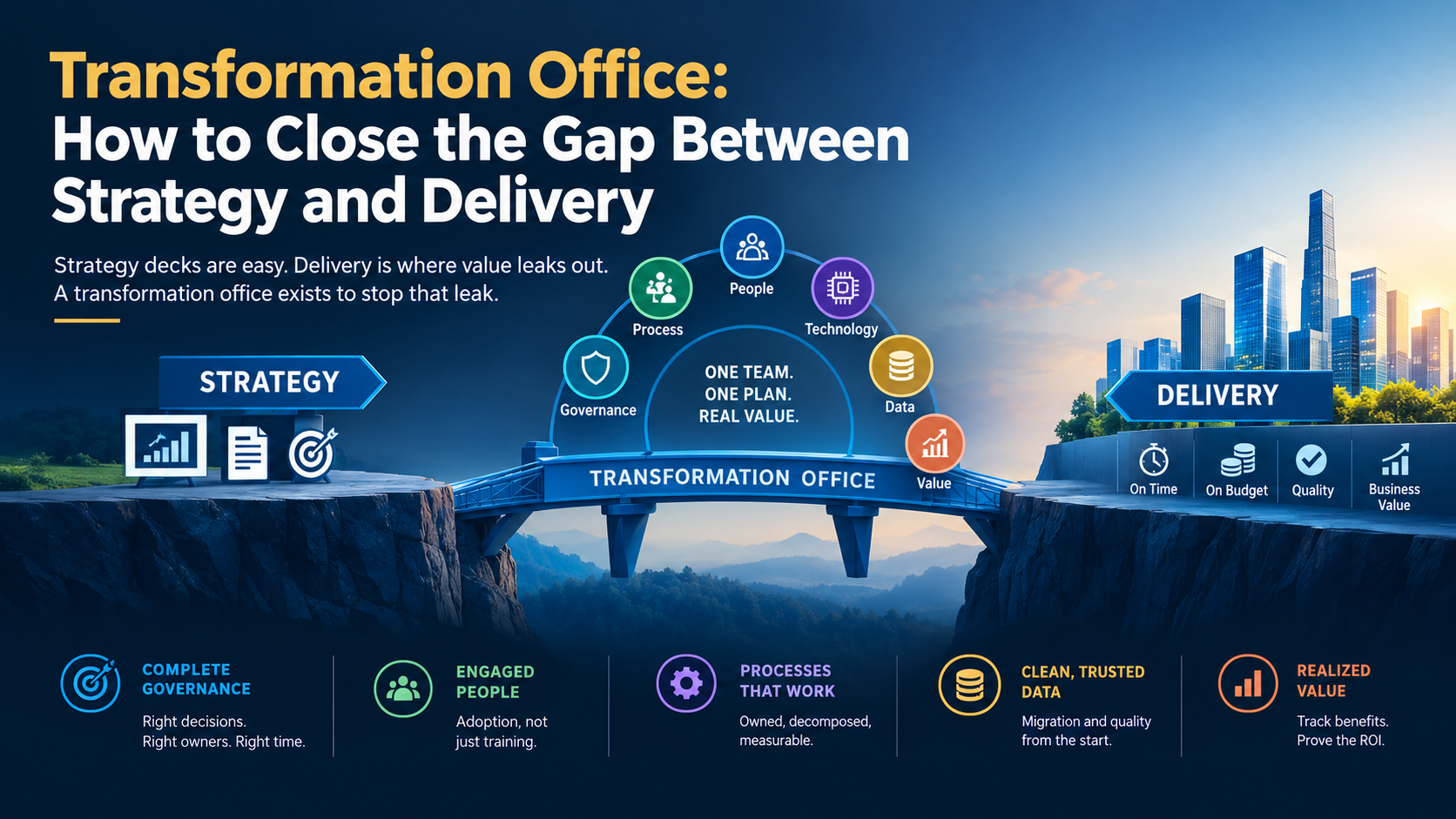
What a transformation office does
It is the single function accountable for connecting strategy to execution across a transformation. Not a status-reporting team. Its job is to decide, prioritize, unblock, and prove value.
Core responsibilities:
- Keep every initiative tied to a funded business case
- Govern scope, change, risk, and phase gates
- Balance resources across workstreams
- Track benefits after go-live, not just on-time delivery
Why strategy stalls in execution
Our own experience across seven- to nine-figure programs points to 65% of transformations failing through five repeating patterns:
- Governance gaps: unclear decision rights, no gate discipline
- People neglect: adoption treated as an afterthought
- Process chaos: no decomposed, owned processes
- Data disasters: migration left to the end
- Value evaporation: benefits promised, never tracked
A transformation office that only watches the schedule misses four of these five.
How to structure one
1. Mandate. Write what the office owns and what it does not. Get sponsor sign-off.
2. Governance tiers. Steering committee for direction and escalations, program leadership for delivery, workstream teams for execution. Our guide to ERP PMO setup covers decision rights and cadence in detail.
3. Six-pillar coverage. Run governance, people, process, technology, data, and value as one system. The AMIGA Framework is built for this.
4. Gates with evidence. Each phase gate needs entry and exit criteria, owners, and an audit trail.
5. One source of truth. Scattered spreadsheets are where decisions go to be disputed. Keep plan, risks, changes, and data in one governed workspace. See how AMIGO works.
Metrics the office should own
- Business case ROI, NPV, and payback, updated at every gate
- Schedule and budget variance
- Open risks by severity and owner
- Data migration readiness against agreed tolerances
- Adoption indicators
- Benefits realized versus the original case
Common mistakes
- Reporting activity instead of outcomes
- Setting the office up after the program has already drifted
- Ignoring data and process until testing
- No link between delivery and the business case
- Too many meetings, too few decisions
Getting started
If governance is already wobbling, begin with a free program risk audit. For senior support on a critical program, see ERP project leadership. To explore the platform, visit AMIGO software.